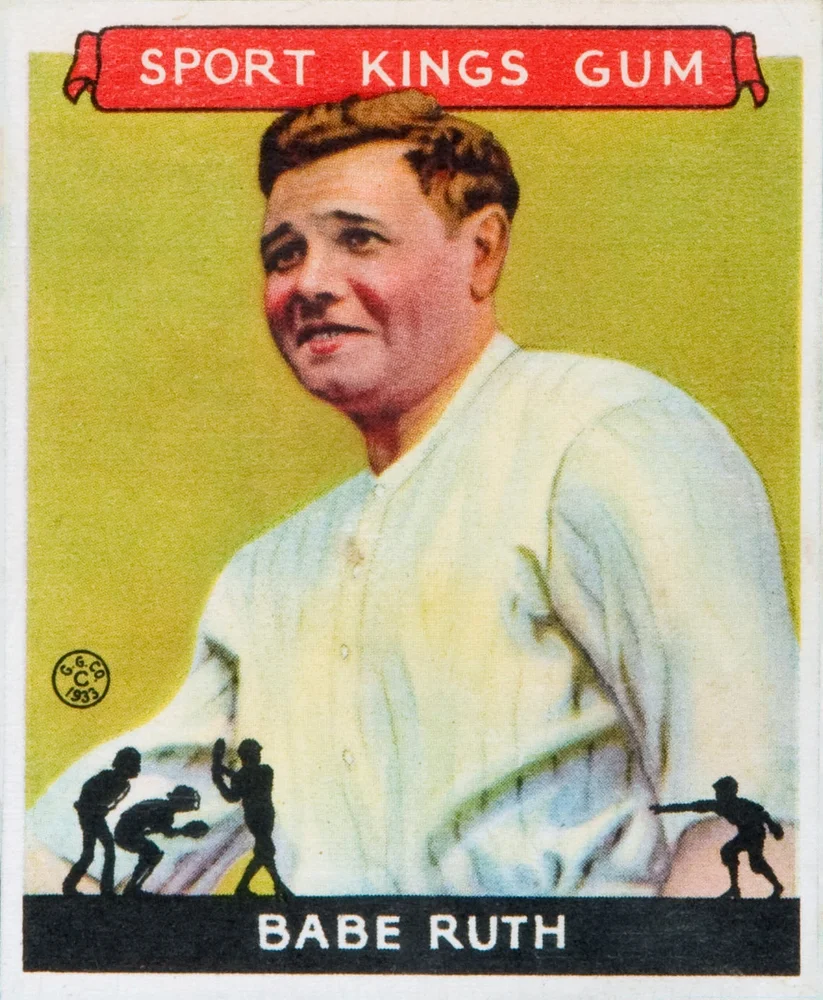
1933 Goudey Big League Gum Primer
If T206 is the old cathedral, 1933 Goudey is the bright loud storefront that changed the block.
This is the gum issue that made color matter, star clustering matter, and card design matter in a way even non-collectors can still recognize. It is not subtle. That is part of the appeal. Goudey wanted these cards to hit kids in the face from across the counter, and ninety years later they still do.
The core facts
The set runs 240 cards. It gives you Hall of Famers, stars, colorful backgrounds, and a paper stock that can still look fantastic or deeply tired depending on how the card lived.
The headline cards are obvious:
- four Babe Ruth cards: #53, #144, #149, #181
- Lou Gehrig cards including #92 and #160
- Jimmie Foxx, Dizzy Dean, Lefty Grove, Mel Ott, and other major names
- the famous Nap Lajoie #106, which was not packed the same way as the regular checklist and became the set's weird scarcity story
Lajoie matters because it teaches a useful lesson: scarcity in a vintage set is not always tied to star power. Sometimes distribution itself creates the demand gap.
Why collectors love Goudey
Because the set looks like it knows it is important.
The portraits are bold. The colors are saturated. The nameplate bars are clean. When a 1933 Goudey card is centered and bright, it has real wall power. That is not just collector poetry. It affects price.
A lot of prewar material demands historical appreciation first. Goudey can win you over on visuals alone, then keep you around with checklist depth.
What the market actually pays for
Three things dominate:
- the Ruth cluster
- color and centering
- surviving surface quality
The four Ruth cards are a market inside the market. Each has its own feel, but all of them carry demand beyond set builders. Gehrig follows. Foxx, Dean, and the next tier of stars ride behind that. Commons are not cheap filler in stronger grades, but the stars control the oxygen.
Condition wise, Goudey is a front-driven issue. Chipping at corners and borders is common. Surface wear can dull the image fast. Registration and focus matter more than casual buyers expect. An otherwise decent card with dead print can feel flat compared to a slightly lower-grade copy with live color.
The Lajoie lesson
Card #106 Nap Lajoie exists outside the normal rhythm of the set because collectors had to request it later after noticing the number was missing from packs. That created a different survival pattern and a different scarcity profile.
What matters here is not just the story. It is the market behavior that follows from it. Lajoie is not Ruth-level iconic in the general public, but the card matters because set completion demands it and supply behaves differently.
Vintage collectors who understand that tend to price scarcity more accurately than people who only shop by player name.
Grading Goudey correctly
Raw 1933 Goudey teaches humility fast.
This issue can hide flaws in color-rich scans. What looks like a clean border at thumbnail size can show chipping in hand. Slight trimming or edge work deserves respect because the upside on major cards is obvious. Surface wrinkles can sit quietly until angled light catches them.
Centering matters, but it is not the only visual driver. A slightly off-center Goudey with strong color and clean surface can be more desirable than a centered but washed-out example. That is why lazy comping fails here.
The best copies feel loud. The weak ones feel dusty.
Building the set is different from buying key cards
The Ruth-only buyer experiences Goudey as a star issue. The set builder experiences it as a quality-control war.
Consistency is hard. Centering varies. Corner wear varies. Color varies. Even if you are willing to live in VG and VG-EX, matching the set visually takes work. That is part of why completed runs with coherent presentation feel better than their technical grade averages suggest.
If you are not building the set, the smartest lane is often selecting star cards where the front image does most of the work. Ruth #53, for example, gets so much attention because the pose and composition are instantly recognizable. But lower-tier Hall of Famers can still offer a lot of the same set beauty without the same tax.
Common mistakes on Goudey
Treating all four Ruths as interchangeable
They are not. Each has its own collector following, presentation style, and price behavior.
Underpricing color
Washed-out Goudey is a different product from saturated Goudey, even inside the same numeric grade.
Ignoring back damage
Many collectors focus front-first, which is rational, but back paper loss and heavy staining still change exit value. Especially when the card is expensive enough that advanced buyers will care.
Forgetting that scarcity can sit outside the stars
Again: Lajoie. Distribution can create pressure points that player hierarchy alone does not explain.
Goudey rewards collectors who separate checklist importance from household-name importance.
Why 1933 Goudey still matters
Because it is one of the clearest early examples of a set where design, checklist composition, and scarcity all pull together. It is historically important, visually alive, and varied enough to support both casual and deep collecting.
It also teaches a useful modern lesson. The market does not just buy "old." It buys cards that feel memorable. Goudey understood that before most companies did.
What to do with this
- When comparing two Goudeys, judge color and surface before you let the numeric grade do all the talking.
- Treat Lajoie and other distribution-driven cards as their own scarcity lane, not just another name on the checklist.
- If you buy raw Goudey remotely, ask for angle shots; border chipping and surface wrinkles disappear in flattering scans.