1952 Topps Set Primer
Everybody starts with the Mantle. Fine. It is the gravity well. But if that is all you know about 1952 Topps, you do not really know the set.
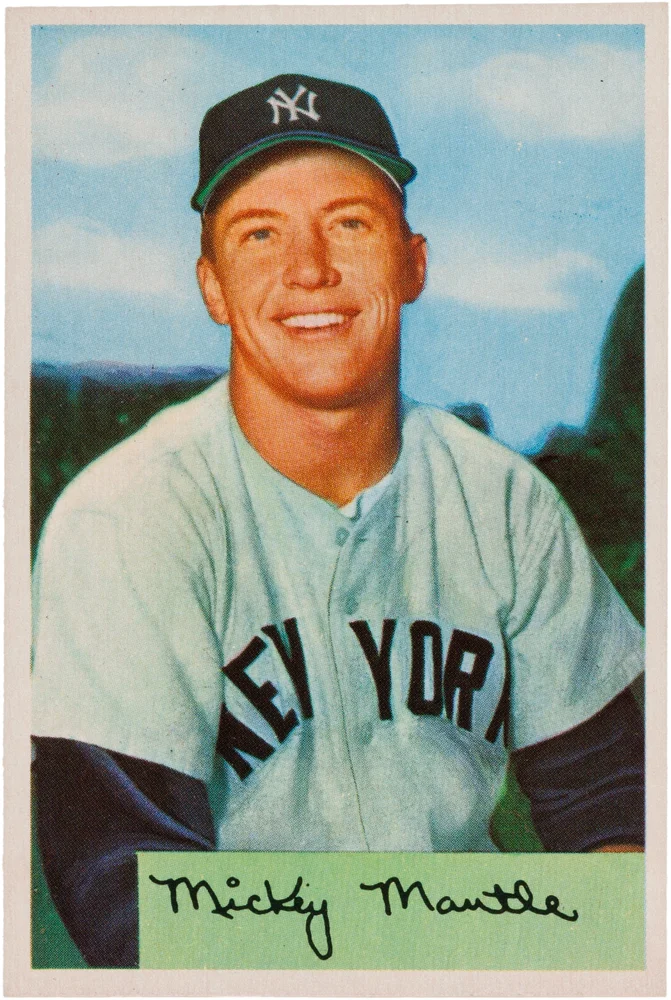
The reason 1952 Topps matters is not just that Mickey Mantle card #311 became the postwar symbol of money. It is that the whole issue taught the hobby how modern cardboard desire works: oversized design, clean player portraits, team-color backgrounds, a true national feel, and a late-series scarcity pattern that still bends prices seventy-plus years later.
The shape of the set
The 1952 Topps baseball issue runs 407 cards across six series. That matters because the market does not treat all six series the same.
Early-series cards are broadly available by vintage standards. The sixth series, cards #311 through #407, are the famous high numbers. Those carry a structural premium because late-season distribution was weaker and surviving supply is thinner. Add in the long-repeated story of unsold stock destruction and you get the hobby's favorite scarcity cocktail: a real distribution issue plus a legend people never stop repeating.
Either way, the effect is visible. High numbers are the hinge point of the set.
Why the design still works
1952 Topps cards are larger than standard modern dimensions, and the extra real estate helps. The front gives you a painted or retouched portrait, a facsimile autograph, and a second action-style pose in a color box. Done badly, that sounds busy. On this set it works.
It works because the portraits carry the card. Mantle, Jackie Robinson, Eddie Mathews, Willie Mays, Duke Snider, and Jackie Jensen all benefit from the format. Even commons can look better than you expect because the set was built to sell personality, not just checklist slots.
That is a real part of value. A beautiful set stays liquid.
The cards that drive the issue
Mantle is the headline, but the set has layers.
The obvious stars:
- #311 Mickey Mantle
- #261 Willie Mays
- #312 Jackie Robinson
- #191 Yogi Berra
- #1 Andy Pafko
- #407 Eddie Mathews
Pafko matters because card #1 is condition-sensitive and handled more. Mathews matters because card #407 closes the set and is a brutal high-number Hall of Famer. Mays is not a rookie, but it is one of the most collected cards of the era. Robinson #312 sits right next to Mantle in the high-number run and gets pulled into the same scarcity conversation.
Collectors who only price Mantle miss how many serious cards live underneath it.
First-series variations and other wrinkles
The first 80 cards include red-back and black-back variations. They are not the engine of the set the way high numbers are, but they matter if you are building carefully. This is one of the early tells that 1952 Topps is not a one-card issue. It has enough internal texture to keep advanced collectors interested.
Condition quirks matter too. Print focus can vary. Registration can wander. Surface wear on the dark color fields shows faster than newcomers expect. Corners on the larger stock do not forgive handling.
Condition on 1952 Topps is not generic vintage condition
You cannot grade these cards lazily.
Centering is a major value driver because the borders and portrait layout make off-center cuts obvious. Corner wear matters, but a nicely centered mid-grade card can beat a technically better but ugly copy. Gloss matters. Surface scuffs matter. Stains on the reverse matter less to display collectors, but they still matter.
High numbers add another twist: because the cards are expensive and the spread between grades is real, restoration and trimming risk deserve respect. Big stars in nice raw condition should be treated with suspicion until the size, edges, and story line up.
A 1952 Topps card can be expensive, famous, and still priced wrong if the eye appeal story is off.
Building the set versus buying the stars
There are basically three ways people enter 1952 Topps.
1. One-card buyer
This is the Mantle path. Expensive, obvious, highly liquid, and loaded with authentication and condition risk.
2. Star run buyer
This is smarter for many collectors. Mays, Robinson, Berra, Campanella, Feller, Mathews, Snider, and other major names give you most of the visual and historical satisfaction without forcing one giant check.
3. Set builder
This is where the issue becomes a real project. Commons are not throwaways, high numbers will test your patience, and condition consistency becomes its own challenge. A mismatched 1952 set looks chaotic fast because the design is so bold.
Set builders also learn an important market lesson: common scarcity plus condition sensitivity can matter almost as much as star power once you are deep enough into the checklist.
What actually moves the market
Three things:
- iconic star power
- high-number scarcity
- eye appeal
The market talks about grade because it needs shorthand. The money often moves on presentation. A centered VG-EX Robinson can beat a weakly presenting higher-numbered holder. A clean Mathews high number with strong color gets remembered. A washed-out copy does not.
That is also why 1952 Topps remains useful to study. It teaches that vintage demand is not one-dimensional. Scarcity alone does not do it. Design alone does not do it. Condition alone does not do it. This set wins because all three line up.
Where collectors get burned
They get burned by paying for the story instead of the copy.
They see "1952 Topps high number" and forget to look at centering. They see "raw Mantle" and stop asking if the size is right. They see a clean holder and ignore a dead front. They price against headline auction sales instead of the quality of the actual card in front of them.
The smarter move is to segment the set in your head:
- early series versus high numbers
- stars versus commons
- centered examples versus tolerated examples
Once you do that, the pricing starts to make sense.
Why the set still matters
Because it is the first postwar baseball issue that feels fully modern in the way collectors chase it. Registry competition, centerpiece star cards, condition scarcity, legendary late-series difficulty, and museum-level visual appeal all meet here.
Plenty of sets are older. Plenty are rarer. Very few are this good at being collected.
What to do with this
- Split any 1952 Topps research into early series and high numbers before you compare prices.
- Judge eye appeal separately from grade, especially on centered mid-grade stars.
- If you are buying raw, treat size and edge review as mandatory on any major star or high number.