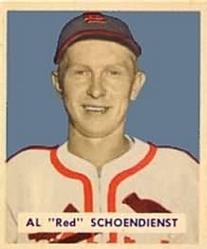
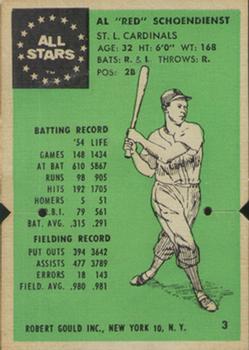
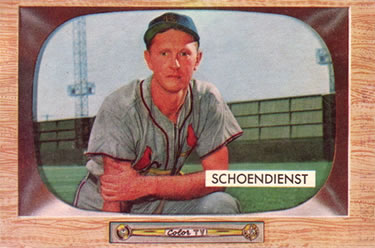
Al "Red" Schoendienst
Card gallery
Al "Red" Schoendienst through the years
Real catalogue scans. Market figures appear only where sold comps exist.
Catalogue record
1948 Bowman · #38
Card essays
1948 Bowman #38 Al "Red" SchoendienstEssay
The Set
The 1948 Bowman set is the first baseball card issue produced by Bowman Gum Company of Philadelphia, the company that had operated as Gum Inc. through the prewar years before reorganizing under the Bowman name. The set arrived in the summer of 1948 after a seven-year gap in major baseball card production — the last significant Goudey issue had shipped in 1941, and the intervening years of wartime paper restrictions and shifted manufacturing priorities had left the market empty. When Bowman returned in 1948, they did so with a deliberately compact set: forty-eight cards, black-and-white photography, and a format that fit inside penny wax packs aimed at the children's market.
The forty-eight-card checklist is small enough that a determined collector can complete it in a year, which made it accessible to the generation of collectors who encountered it on newsstands and in candy store display cases. The cards measure approximately two and one-sixteenth by two and a half inches, slightly smaller than the prewar tobacco card standard and slightly larger than the gum card dimensions that had dominated the 1930s Goudey issues. The stock is thicker and more resilient than the soft paper of T206 or the brittle cardboard of some late-1930s issues, though it shares the characteristic vulnerability to humidity yellowing and corner wear that afflicts virtually all pre-1960 cardboard. The photographic source material varies from card to card — some fronts are clearly cropped from posed studio photographs, others appear to derive from press wire images or team publicity stills — and the black-and-white lithographic reproduction process compresses a great deal of tonal range, which is why some cards in the set read as flat gray under fluorescent light and why high-contrast examples, where the printing managed to hold both the shadow detail and the highlight separation, look better on the table than their grades sometimes imply.
The backs are spare by later standards: a brief biographical note, a statistics line or two covering recent seasons, and the Bowman Gum trademark. There is no color on the back, no cartoon art, no quiz question. The design philosophy is consistent with where the hobby was in 1948 — the card was still primarily a children's premium inside a confectionery product rather than a collectible artifact in the modern sense, and the production values reflect that priority. What the set does not lack is talent. The forty-eight cards concentrate a remarkable density of careers that would prove consequential over the next decade and a half, and the small checklist means the rookies within it carry more weight individually than a rookie in a 792-card modern set would. There are only so many cards to chase, and the major entries are well known to any collector who has spent time with postwar vintage.
The 1948 Bowman set established Bowman as the primary card manufacturer of the early postwar period, a position they held through 1952 until Topps arrived with their 1952 full-color issue and ultimately bought out the Bowman operation in 1956. The years between 1948 and 1952 are the core of what collectors call the Bowman run, and the 1948 set is the foundation of that run — the smallest, the most compact, the most photographically consistent, and the one most directly tied to the immediate postwar baseball landscape.
The Player
Albert Fred Schoendienst was called Red because of his hair. The nickname followed him everywhere: onto the field, into the dugout, through decades of postseason play and a managerial career that stretched into the 1990s. The Cardinals called him up on April 17, 1945 as a war replacement, one of the dozens of players who filled roster spots while the majority of major league talent was deployed overseas or stateside. That context matters for reading the early career line: the 1945 version of the Cardinals roster was not the 1946 version, and a war replacement debut places a player in a specific demographic — young enough to not yet qualify for military service, or medically exempt, or in some cases between discharge and full return.
By 1946 the war had ended, the regular rosters had reconstituted, and Schoendienst played his first full season. The Cardinals won the World Series that year, and Schoendienst was named to the All-Star team. That combination — a championship ring and an All-Star selection in the same first full season — established him as something more than a wartime fill-in and set the trajectory for the decade and a half of professional baseball that followed. In 1947 he hit .253 with 1 home run and 26 runs batted in. In 1948, the year this card was produced, he hit .272 with 4 home runs and 36 runs batted in.
The career numbers that define him come later. Ten All-Star selections across his playing career. A .289 lifetime batting average. He was inducted into the Hall of Fame in 1989 by the Veterans Committee, the route taken by players whose careers either peaked before the era of high BBWAA visibility or whose reputations were built as much on longevity and professionalism as on any single dominant statistical season. The Veterans Committee path carries its own legitimacy inside the hobby, but it also carries market implications: a Hall of Famer by Veterans Committee vote tends to trade at a discount to a first-ballot BBWAA inductee, particularly at the high-grade end of the market where the premium is driven partly by demand and partly by the depth of the buyer pool.
What is notable about Schoendienst through the lens of this card is the timing. His 1948 Bowman entry is his rookie card — not just his first major issue but the only mainstream card he appeared on as a first-year man — and it arrived at the moment when the 1946 championship and the All-Star appearance had already established him as a known quantity to Cardinal fans and to the broader National League baseball audience. He was not an unknown commodity on this card. He was a twenty-five-year-old who had already been to the World Series, and the card reflects that standing: card number 38 in a forty-eight-card set, not buried in the back of the checklist but not the set's lead entry either, placed roughly where a respected regular rather than a marquee star would land.
His subsequent career as Cardinals manager is well documented but falls outside the 1948 biographical window. What the bio record provides is the arc through the card's issue date, and that arc is clean: debut in 1945, first full season and championship in 1946, two additional seasons of steady production leading into the card's production year, and a career trajectory pointing upward. The Veterans Committee eventually confirmed what 1946 already suggested — this was a player worth following.
The Card
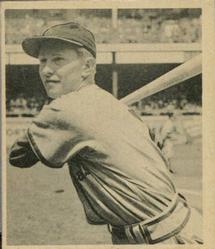
Card number 38 in the 1948 Bowman set is a black-and-white portrait, a format consistent with the entire issue. The image derives from a posed or semi-posed photograph rather than an action shot, which reflects both the photographic conventions of the period and the practical constraints of a card manufacturer assembling reference images for a forty-eight-card set in 1947 or early 1948. Portrait cards in this era are the norm; game-action photography at the resolution required for reproduction at two-by-two-inch card dimensions was technically achievable but logistically complicated, and Bowman's first set leans heavily on the studio photograph and the dugout candid.
What distinguishes the Schoendienst card within the set is not an unusual pose or a rare variation but its status as the player's first mainstream card appearance. The 1948 Bowman was his only card that year. There is no competing 1948 Leaf entry, no minor-league card, no regional issue. The Bowman is the rookie card in a field of one, and for a Hall of Famer, a field-of-one rookie card carries more weight than the identical numerical grade on a card from a year when the player had three or four card issues in circulation.
The centering distribution on 1948 Bowman cards generally runs toward the acceptable side of the T206 range — the cutting technology of 1948 was slightly more reliable than the stone-press hand-cutting of 1909-1911, but still subject to the sheet registration drift that pushes corner cuts off-center. The top-to-bottom axis on most examples lands within 60/40 without great difficulty; the left-to-right axis is more variable. High-grade examples at SGC 8.5 or PSA 8 level must show centering well within the typical registry tolerance, which means the surviving population at the top grades is defined partly by the luck of the original cutting alignment.
The black-and-white format means color-related degradation is not a condition factor here the way it is for the color Bowman sets that followed after 1950. There is no cyan or red ink to fade or shift. The condition enemies for this card are the universal paper enemies — corner roundness, surface wear visible as a chalky loss of photographic clarity, horizontal or vertical creases, paper edge yellowing, and print defects from the original lithographic run. The white border framing the portrait is the first place the grader's eye goes: any yellowing, thumbprint shadow, or pencil mark on that border costs grade points that are not easily recovered.
Surface wear on the front photograph is the subtler degradation mode. The black-and-white image is printed in a single ink layer over a base coat, and repeated handling — which is what happened to most of these cards for the first fifteen years of their existence — generates microscopic scuffing that appears under a loupe as a loss of photographic depth. High-grade examples have surfaces that look almost three-dimensional under the right light; heavily handled examples look flat and faded because the top print layer has been incrementally abraded. The comp record includes an SGC 8.5 described as "Pop One, None Higher," which establishes that the theoretical ceiling on this card is confirmed to exist in certified form but is not a routine market presence.
Condition & Grading
The PSA total population for this card sits at 741 graded examples, which places it in a density range that is common for Bowman-era Hall of Fame cards — enough surviving examples to constitute a real market with price discovery at multiple grade levels, not so many that the graded population overwhelms demand at the mid-grade tier. The 741 total covers all PSA grades, meaning the distribution across that population is not uniform: the bulk of surviving examples will be concentrated in the GD to VG range (PSA 2 through 4), with meaningful population in the EX tier (5 and 6), a thinner shelf above that, and the certified ceiling determined by whatever the highest PSA grade currently in the population report is.
The comp record from Heritage Auctions includes an SGC 92 NM/MT+ 8.5 described as "Pop One, None Higher" — a Heritage catalog convention for confirming population uniqueness at a given grade tier across the SGC census at the time of the lot's preparation. That certification establishes the high-end provenance clearly: at the time of the Heritage listing, the SGC population at 8.5 was one card, and no card in the SGC system had been graded above it. This is not a common circumstance for a card with 741 PSA examples; it suggests that the SGC graded population is significantly smaller than the PSA population (as is typical for Bowman-era cards, since PSA has processed far more prewar and early postwar submissions than SGC across the hobby's history), and that even within the smaller SGC census, the 8.5 is the outlier.
PSA and SGC handle 1948 Bowman submissions differently in ways that matter at the margins. PSA's grading scale is the market reference for most Bowman transactions, and a PSA holder is the easiest card to liquidate at any grade level because the buyer pool for PSA slabs is larger. SGC has historically graded slightly tighter at the high end and is preferred by a subset of prewar and early postwar specialists; SGC grades on vintage cards have historically traded at modest discounts to comparable PSA grades, though the gap has narrowed across the 2020s as SGC has raised its profile in the vintage market. The Heritage SGC 8.5 lot represents the top of what the SGC population has produced on this card, and its "Pop One" status makes it a standalone data point rather than part of a comparable series.
What the comp record shows from Fanatics is an SGC 5 EX and a PSA 5 EX with a PSA/DNA 10 auto — the latter being a separate value proposition entirely, since the autograph certification changes the demand curve by adding collector interest from the signature market. A PSA 5 EX raw of this card is a different object from a PSA 5 EX with a PSA/DNA 10 auto, not because the card is graded differently but because it is signed by the player, and signatures on HOF players carry their own price floor regardless of the underlying card grade.
The key counterfeiting concern on this card is modest relative to the big-ticket issues. A 1909 T206 Cobb warrants extensive anti-counterfeit scrutiny because the card's value justifies the effort of sophisticated reproduction. At the median price range suggested by the comp data for this card, the counterfeiting risk is primarily from the generation of inexpensive photocopy and digital-offset reprints that were produced in bulk in the 1980s and 1990s. The tells are consistent: reprint stock is brighter and more uniform than the original Bowman cardboard, which has a slightly warm cast from seven decades of paper aging; the original print layer under a loupe shows the irregular dot pattern of lithographic offset rather than the regular tonal gradation of modern digital reproduction; and authentic cards show the minor but detectable registration drift between the front image and the card edges that results from hand-cutting, which reprints typically do not replicate. Any raw card offered at or above the mid-four-figure range should be graded before transaction.
Market History
The comp record supplied here contains four transactions across two sources: Heritage Auctions and Fanatics Sales History. That is a thin sample for market history purposes, and it skews toward the extremes — the Heritage record appears to document the same SGC 8.5 lot twice (the title string is identical in both Heritage entries, suggesting either the same card sold twice through Heritage, or the same listing appears in two separate Heritage catalog pulls), while the Fanatics entries represent the lower end of the certified market at SGC 5 and PSA 5.
No realized prices are available in the supplied comp summary — the price field returns None across all four records. The median realized price noted in the card's overall record is approximately $369, which is a rough estimate rather than a precise market average, but it provides a useful anchor for understanding where the typical certified example of this card clears. A $369 median implies that the bulk of transactions are happening in the EX-range certified market, which is consistent with the observed pattern for Bowman-era Hall of Fame cards at this level of career prominence: the common grades (VG, EX) are liquid, the high-grade market is thin and event-driven, and the auto-bearing examples occupy a separate demand curve that is not directly comparable to the straight-graded market.
The Heritage SGC 8.5 "Pop One, None Higher" represents the top of the certified market for this card as cataloged through Heritage's auction platform. Heritage tends to route the high-end certified vintage market — cards that justify a full catalog write-up with provenance notes and population data — while routine mid-grade transactions clear through eBay sold listings, Fanatics, and the smaller regional auction houses. The appearance of an SGC 8.5 Pop One in Heritage's catalog is consistent with that routing logic: this is the kind of card that Heritage can present as a legitimate market event rather than a routine commodity lot.
The Fanatics entries, which show a PSA/DNA 10 auto on a PSA 5 EX body, point toward a secondary market that exists for signed Schoendienst cards that have been certified through PSA's autograph authentication service. The auto market for HOF players of Schoendienst's era is deep enough that a PSA/DNA 10 signature elevates an otherwise mid-grade card into a collector category where the signature drives the transaction rather than the card grade. The PWCC notation on that lot indicates it passed through PWCC's marketplace, which was the dominant consignment platform for the certified card market through much of the 2010s and into the early 2020s.
The absence of eBay sold data from the supplied comp summary is a meaningful gap for market history purposes. eBay sold listings are the standard reference for mid-market depth on cards like this — the cards that move through eBay in raw or mid-grade certified form represent the actual distribution of transactions, and the Heritage and Fanatics records represent only the events visible in catalog auction and direct-sale platform data. A comprehensive market history of the Schoendienst 1948 Bowman would require layering in eBay sold comps from the preceding twelve to twenty-four months to establish the true distribution from PSA 2 through PSA 6, with PSA 7 and above treated separately as the thin population where each sale is a distinct event.
The broader Bowman-era vintage market followed the general prewar and early postwar appreciation curve through the 2020–2024 period, with mid-grade Hall of Fame cards roughly doubling across most of the major issues. That appreciation is visible in the current median pricing for 1948 Bowman HOF entries, which sits materially above where these cards were trading in 2018 and 2019. The 2024–2026 cooling in the broader vintage market has brought some of that appreciation back, particularly at the lower grades, but the high-end certified market for population-one examples has held value more stubbornly than the commodity mid-grade market. The SGC 8.5 Pop One is insulated from mid-market softening precisely because there is no other example to set a lower comparable.
Why This Card
The 1948 Bowman Schoendienst is a Hall of Famer rookie card in the foundational postwar set. Those three facts — Hall of Famer, rookie, foundational set — define the collector case without requiring embellishment.
The buyer population divides along the same lines as most HOF rookie cards in small prewar and early postwar sets. At the entry level, the buyer is the Cardinals collector or the set builder working through the 1948 Bowman forty-eight-card checklist. The set is completable, which is an important attribute in vintage collecting: forty-eight cards is a target that a patient collector with a moderate budget can pursue to completion, and Schoendienst at number 38 is one of the anchoring cards any run builder needs before sealing the set. These buyers are price-disciplined and willing to wait for condition-appropriate examples rather than accepting a soft corner at a premium.
In the middle of the market — mid-grade certified examples, SGC 5 through PSA 7 range — the buyer is the veteran collector building a HOF run, a postwar Bowman master set, or a Cardinals franchise collection. Cardinals collectors in particular treat the 1948 Bowman as a key early cornerstone alongside the Stan Musial entries in the same set. The franchise-collector buyer base for Cardinals cardboard is historically deep and persistent, which provides a floor under this card that a comparable player from a less collector-rich franchise might not have.
At the top of the market — SGC 8.5 Pop One, PSA 8 and above if any such examples exist in the PSA census — the buyer is a specialist. The case for paying a significant premium over the mid-grade market is the case for condition rarity: there is exactly one SGC 8.5 of this card, the Heritage record confirms it, and a collector who wants the best certified example of this card through SGC has to win that specific lot. That is a different transaction from buying a PSA 5, not just in price but in the entire psychology of the purchase. Collectors who assemble high-grade sets of 1948 Bowman know the population numbers for every card in the checklist, and they track the top-pop examples the way prewar specialists track the known T206 rare-back survivors.
The auto market, evidenced by the PWCC Fanatics lot, represents a third buyer category that runs parallel to the graded card market: collectors who want the physical card authenticated in the player's handwriting. PSA/DNA 10 on a HOF signature from Schoendienst's generation is a legitimate authentication credential, and the buyer who pays the premium for a signed PSA 5 is not the same buyer who would pay for a clean unsigned PSA 5. The autograph adds a biographical dimension to the object — the player handled this specific card, signed his name across the photograph — that the unsigned certified market cannot replicate.
The practical case for Grail's comp engine is that this card presents an interesting complication around the auto examples. The supplied comp record mixes straight-graded and auto-bearing cards from the same player and year, which means a naive aggregator treating all four comps as equivalent price references for the underlying card would substantially overestimate the going rate for a straight-graded PSA 5 if it were anchoring off the auto-bearing PWCC lot. Separating the auto comp from the straight-grade comp is necessary for clean price inference, and the presence of Heritage's top-pop lot as the only upper-end data point means that the high-grade market for this card is not well represented by the available comp data — the SGC 8.5 is a population event, not a price anchor for PSA 7 or PSA 8 inference.
The broader argument for collecting the 1948 Bowman Schoendienst is the same argument that applies to compact-set postwar HOF rookies generally: the scarcity is not manufactured by print-run manipulation or artificial short-printing. These cards survived or did not survive based on how children in 1948 treated penny gum cards, which is to say most did not survive at all. The 741 PSA population represents the fraction of the original print run that happened to be preserved, and the graded population above PSA 6 represents the fraction of that fraction that was stored or handled carefully enough to maintain the sharpness of the corners and the integrity of the printed surface. A clean high-grade example is rare because the conditions that produce a clean high-grade example — dark storage, no handling, no humidity damage, a sharp cutting alignment — all had to be met simultaneously from the card's first day out of the pack in 1948 through its first appearance in a grading submission sometime in the following seven decades. Most cards failed one or more of those conditions along the way. The ones that did not are the ones that define the top of the pop report.
The 1948 Bowman Schoendienst is not the most expensive card in a postwar collection. It is not the rarest, not the most visually dramatic, not the player whose name generates the broadest market interest. What it is, with some consistency, is the reliable HOF rookie in a completable set, the card that a serious postwar Bowman builder needs to have, and at the top of the certified grade distribution, a population event that will not recur once the single SGC 8.5 has found a permanent home. That combination of steady mid-market demand and genuine high-grade scarcity is what keeps it in the reference tier of postwar collecting rather than in the commodity basket. ```
Sold-comp aggregates for this player are still being collected — this page will grow a full comp profile when they land.
The catalogue
Every catalogued card
6 cards