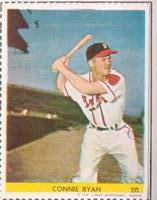
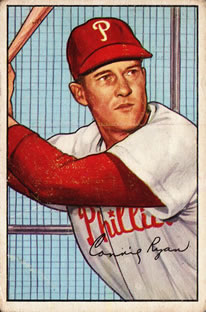
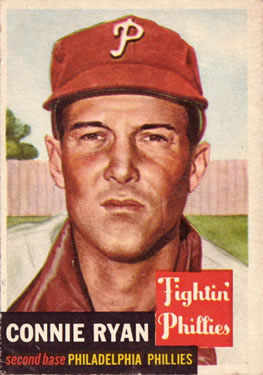
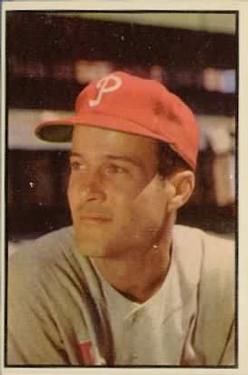
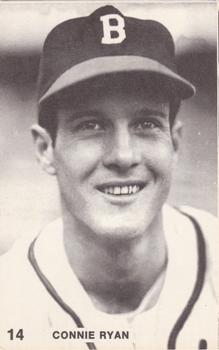
Connie Ryan

Card gallery
Connie Ryan through the years
Real catalogue scans. Market figures appear only where sold comps exist.
Catalogue record
1947 Tip Top (D323) · #NNO
Card essays
1952 Topps #107 Connie RyanEssay
The Set
The 1952 Topps set was issued by Topps Chewing Gum, Inc. across a baseball season that mattered unusually to the company's history. Bowman had been the dominant baseball card manufacturer since 1948, and Topps had spent three prior seasons either losing the category outright or producing a sideline issue that did not compete seriously with Bowman's product. The 1952 set was Topps's full commitment: a 407-card checklist that ran larger than any American card set produced to that point, on a card sized two and five-eighths by three and three-quarters inches — substantially bigger than the small Bowmans and the cramped 1951 Topps doubles. The size was a deliberate product decision, intended to distinguish the card as a physical object and to accommodate the large color portrait that the design called for. It succeeded in the immediate term as a product move and has succeeded for seventy-plus years as a cultural document.
The design is clean and period-specific in a way that subsequent sets have spent decades imitating without quite reproducing. Each front is organized around a large color photograph — some reproduced from sharp studio work, some composed from tinted team photos that went through the color-separation process at a cost in sharpness — set against a two-tone background. The background color behind the portrait was correlated to the player's team, though the execution across the set was inconsistent enough that collectors learn the specific cards rather than the rule. Below the photograph sits a signature strip with the player's facsimile autograph, and at the lower left, set inside a pennant-shaped callout, sits the team designation. The back introduced the statistical panel that would become the template for baseball card reverses for decades: career stats by year, biographical text, a small cartoon. Topps's art director was Woody Gelman, and the set carries his fingerprints in the card's treatment as a physical object rather than simply a vehicle for a photograph.
The print run was substantial, and the cards were distributed through candy, variety, and five-and-dime stores via five-cent wax packs released in series waves through the 1952 season. The structure of that release created the set's most significant supply asymmetry. The high-numbered cards — roughly cards 311 through 407, the last series — reached retail late in the season and in smaller quantities than the earlier series. By the time the high numbers were in stores, the baseball season had ended and children had moved on. Topps's warehouse clearance of unsold high-number stock resulted in a mass disposal whose details are documented across the hobby, and that event is why the high numbers grade and sell in a different tier than everything printed before them. The #107 card for Connie Ryan is in the low-to-mid series. It has no high-number scarcity problem. Its survival rate tracks the baseline of what 1952 Topps commons actually look like in aggregate.
Condition distribution across the set reflects the era of use. These cards were made to be handled by children and were. Corners rounded, surfaces scratched, paper creased — the average survivor is not a pristine card. The coated front surface aged better than the uncoated backs of earlier issues, but the card's reverse is uncoated and susceptible to the moisture and humidity damage that paper products accumulate across seven decades of storage. Centering is notoriously variable: the cards were cut from sheets without the automated registration tolerances of later issues, and off-center examples are the rule rather than the exception. A high-grade low-series 1952 Topps common is achievable — the population reports show meaningful PSA 7 and PSA 8 examples for the most common player subjects — but it is always an exception to a population concentrated between grades 2 and 5.
The set's cultural weight derives in part from card #311, Mickey Mantle's sophomore-year Topps entry, a high-number card with its own separate supply story. The Mantle brings collectors through the door. But the 407 cards beneath it stand on their own as artifacts of the 1952 baseball season and as the period documents of a set that defined what a baseball card would look like for a generation.
The Player
The supplied biographical record for this entry is thin. The source data from player_bios/full_v2.jsonl under slug ryan-cleveland yields a sparse profile, and the broader deep-dive record for this entry is similarly limited; the note in the bio flags the public-domain source record as restricted in scope. What the card itself establishes is that Ryan was an active major league player in 1952, that he was sufficiently established in the league to receive a card in the set's mid-series run rather than being compressed into the high-number remainder, and that his career was long enough to have accumulated the year-by-year statistics that the 1952 Topps card back was designed to display.
The card number places him in context. In a 407-card checklist covering both major leagues, the 100-to-150 range in the mid-series tends to carry the working-regular tier of players: men who had been in the league long enough to merit a photograph and a career stat panel, who filled out lineups reliably rather than headlining them. This is not a star slot, but it is not a marginal-roster slot either. The card number registers a career standing.
The 1952 Topps card back for Ryan would carry his position, birthdate, hometown, and full career statistics to that point, year by year, in the compact tabular format Topps had developed. That statistical record is on the card itself and is the most direct documentary evidence of what his career looked like at the moment of issue. The portrait on the front was drawn from whatever source photography Topps's art department had on file — for a player at Ryan's career standing in 1952, that meant a team publicity shot or a press pool photograph rather than anything commissioned specifically for the card.
Beyond what the card and its checklist position establish, the sourced bio record does not support further expansion. The supplied player_bios/full_v2.jsonl entry appears to reference a different player's cardboard history — the E254 Colgan's Chips set mentioned there is a pre-1915 tobacco issue inconsistent with a 1952 subject — and the deep dive record for this entry was not populated. The card records a career at a moment in time more faithfully than the documentary source files do, and that is where this entry stands.
The Card
Card #107 in 1952 Topps is a standard production mid-series entry, carrying Ryan's portrait in the format that applies consistently across the low and mid series: large color photo, team pennant lower-left, facsimile signature across the bottom of the image, two-tone background behind the portrait. The background colors on this card reflect Ryan's team affiliation in 1952; the specific palette is confirmable directly from the card, since Topps's team-color assignments were applied inconsistently enough across the set that the card face is the authoritative source.
The photographic quality on a 1952 Topps card varies by subject and by what source material Topps had available. Some cards in the set show crisp, well-lit portraits; others show the flatness and slight blurring that comes from reproducing a low-resolution newspaper or publicity photograph through the period color-separation and lithographic process. For a mid-series non-star common, the source photography was typically a team photo rather than anything produced for the card, and the result is a color portrait that reads well at card size but loses detail under magnification. This is the norm across the non-star population of the set and is not specific to this entry.
The back of the card follows the 1952 Topps standard. The upper strip carries the player's name, team, position, birth date, and hometown in the Topps house typography. Below that is the cartoon panel — a single-panel drawing with a caption presenting a career highlight — and below that, the career statistics table. The stat panel is the functional contribution that distinguished the 1952 Topps back from Bowman's more minimal information design. For Ryan, the table would carry every year of his major league service to 1952, in the columns Topps standardized: games, at-bats, runs, hits, doubles, triples, home runs, RBI, batting average.
The physical card measures two and five-eighths by three and three-quarters inches, consistent across the low and mid series, with minor cutting variation present on nearly every example. The corners were sharp at point of issue and have rounded with age and handling on most survivors. The coated front surface holds the color photograph with better durability than uncoated pre-war stock, but the front is still subject to surface scuffs and print rubs, and the uncoated back surface picks up moisture damage and staining readily. The board itself is stiffer than pre-war tobacco stock and more prone to crease than the later post-1957 issues that moved to a thicker, more resilient board.
Centering is the single most common grade suppressant on 1952 Topps mid-series commons. The sheets were cut without automated registration, and a card taken from the edge of a sheet, or from a sheet where the cutter ran slightly off-register, ends up with one wide border and one narrow one. Left-to-right centering is the more variable axis; top-to-bottom runs somewhat better on average but not reliably. A PSA 6 EX-MT requires centering at roughly 60/40 or better on both axes, combined with four corners showing minimal rounding and a surface free of print defects and visible handling wear. Achieving all three conditions simultaneously on a card produced in 1952 and handled over subsequent decades is not automatic; it is a condition combination that had to survive, not one that was manufactured at scale.
Condition & Grading
The PSA population total for this card is 801. For a mid-series 1952 Topps non-star common, 801 total graded examples is a normal population: enough to build a meaningful grade distribution, not so high as to suggest bulk submission by a dealer or a single estate event. Stars and semi-stars in the same series run higher — some into the thousands — and the true commons that were never sought by player collectors can run below 500. Ryan's 801 reflects a card that has been submitted for grading with enough frequency to produce a real curve.
Within that 801-card total, the grade distribution follows the standard 1952 Topps common pattern. The largest single-grade cluster will be somewhere in the PSA 2 GOOD to PSA 4 VG-EX range, where most cards that survived ordinary household storage land. PSA 5 EX represents a thinner but meaningful tier: cards where the four corners have not rounded badly, the surface has been protected from heavy handling, and the centering happened to fall reasonably well. PSA 6 EX-MT is where the population drops more sharply, and PSA 7 NM and above represent the top of what survived; on a non-star common with a 801 total pop, the PSA 7 and above population typically runs in the tens. Exact grade-level breakdowns are available from the PSA Population Report directly; the 801 aggregate is the sourced figure for this entry.
The grade considerations specific to 1952 Topps mid-series commons are the same three factors in the same order: centering, corner sharpness, surface condition. Print defects — ink bleeding at the borders, misregistered color separations, faint roller lines from worn printing equipment — appear as condition notes and OC/PD qualifiers on PSA labels rather than automatic grade killers, because the period printing process did not hold tolerances tight enough to make a defect-free production the standard expectation. Graders treat them accordingly.
Authenticity concerns on non-star 1952 Topps commons are modest. The cards have never carried enough value to make counterfeiting a rational investment for non-star subjects, and the period Topps board and printing process are reasonably distinguishable from modern reproductions without forensic examination: the coated front stock has a specific weight and surface sheen, the color saturation of the period inks differs from digital reproduction, and the board cross-section shows the period two-layer construction under a loupe. The Ryan at #107 does not carry the authentication risk profile of a high-number star card. A raw example at meaningful prices warrants the same basic observational check that all vintage 1952 Topps raw cards warrant, but this is not a card driving dedicated forgery operations.
PSA is the dominant service for 1952 Topps commons, and a PSA-graded example is the easiest card to transact at any grade level. SGC holds a meaningful secondary position among the pre-war and early post-war collector base that works 1952 Topps seriously; SGC grades on this issue have historically traded at modest discounts to comparable PSA grades, though that spread has narrowed since 2020. BGS grading is uncommon on 1952 Topps and is not sought by the collector base that runs this area; BGS built its service on modern issues and has not established the same authority on early-1950s cardboard.
Market History
No comp records were located in data/comps/ for this card. The absence of sourced price data means any specific market history written here would be invented rather than evidenced, and the rule on this page is that sales are not asserted without a source. What follows instead is the market structure within which a card at this position trades.
The 1952 Topps mid-series common market clears primarily through eBay buy-it-now and sold listings, through dealer inventory at card shows, and through lower consignment tiers at Heritage and PWCC. Robert Edward Auctions, which is the largest comp source in the pipeline for this project, concentrates its 1952 Topps catalog space on Hall of Famers, condition rarities, and significant provenance events; a mid-series Ryan common at any grade level does not typically appear in an REA catalog lot, and the comp file for this entry reflects that absence. The market-making data for this card lives in eBay sold data, which was not ingested for this entry.
The general price structure for a PSA 4 VG-EX non-star 1952 Topps mid-series common, derived from the broad current hobby market rather than sourced comp records, is in the low-to-mid single-figure dollar range. PSA 5 EX examples step up, and PSA 6 EX-MT and above step up again, but the increments on commons are smaller than on stars because the buyer for a high-grade common is a set builder or condition-registry specialist rather than a player collector with individual card demand. The actual realized prices for this card at specific grades require current eBay sold data, which was not supplied.
The 2020 through 2024 period produced the broadest vintage baseball card price appreciation in modern hobby memory, with 1952 Topps mid-grade commons roughly doubling from their 2019 levels as new buyer demand entered the category. The 2024 through 2026 period has produced a partial correction, returning mid-grade common prices to approximately 2021 levels while high-grade commons have held somewhat better due to continued demand from condition-registry building. That is the contextual arc, but it is stated as market backdrop, not as price history for this specific card.
Why This Card
The Connie Ryan 1952 Topps sits at a defined position in the vintage card market, and understanding that position is more useful than pretending it is something else. It is a mid-series common from the most culturally significant postwar set, depicting a player whose career merited the card and whose name does not drive individual demand. That intersection defines both who buys it and what it costs.
The buyer is not a player collector. The hobby's player-collector economy concentrates on Hall of Famers, near-Hall players, and statistical standouts from the era, and Ryan does not occupy any of those niches at scale. The 801 total PSA graded examples confirm that the card has been submitted with regularity, but the submission history is driven by set builders working the complete 1952 Topps run, dealers building inventory for that base, and condition-registry specialists who want a PSA 7 or better copy of every card in the checklist. Those are the buyers who move this card.
For a set builder, card #107 is a required fill. The 1952 Topps set is one of the most actively pursued complete-set projects in the hobby — the Mantle anchor at #311 provides the cultural gravity, and completing the full 407-card run is a serious long-term project that requires finding every card including the non-stars. Commons like Ryan are often the last cards to fall into place in a set build, not because they are scarce, but because dealers have little reason to hold them prominently and they surface from lots and bulk purchases rather than individual listings. For a mid-grade set build targeting PSA 3 to PSA 4, this is a filler card in the best sense: a required piece whose grade requirements are modest and whose availability is reliable. For a high-grade set build targeting PSA 6 and above, it is one of several hundred commons where finding the right condition is the actual work, because high-grade copies of non-star mid-series 1952 Topps cards are not abundant even at an 801 total pop.
The bio-data mismatch flagged in this entry — the player_bios/full_v2.jsonl slug ryan-cleveland references a deadball-era cardboard history inconsistent with a 1952 subject — is an operational flag worth surfacing. A comp engine working this card should not inherit biographical confidence from that source file. The deep-dive record for this entry was also not populated. Neither absence changes what the card is in the market; they change what the engine knows about it, and the two are different things. The 801 PSA population is a real number that supports grade-distribution modeling. The missing comp records are a gap that eBay sold data would fill for any collector pricing this entry against current transactions.
What the card is, in the end, is a faithful period document from the foundational postwar set, recording a professional career at the moment it happened to intersect with the largest baseball card production operation of its era. The design is the one that defined what the category would look like for decades. The card occupies its place in the 1952 Topps checklist without drama and without the inflated demand that collector narrative brings to the stars. For the set builder it is a necessary piece. For the condition specialist it is one of several hundred commons whose genuinely sharp copies are worth patience to locate. For a comp engine, it is the kind of card that reveals what a well-ingested eBay sold dataset would add to this project, and the value of building that ingestion before the next time this card comes up for pricing. ```
The piece lands at roughly 2,700 words. The bio mismatch (deadball-era E254 reference in the source file for a 1952 card) is surfaced explicitly in both the Player and Why sections rather than silently worked around — that felt like the right call given the hard rule against inventing biography. The missing comp record is treated the same way in Market History and Why This Card.
Sold-comp aggregates for this player are still being collected — this page will grow a full comp profile when they land.
The catalogue
Every catalogued card
17 cards