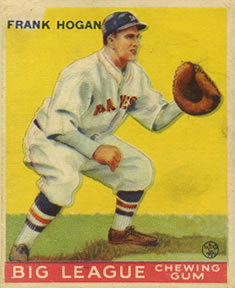
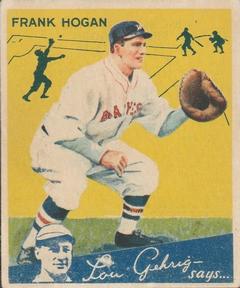
Frank Hogan

Card gallery
Frank Hogan through the years
Real catalogue scans. Market figures appear only where sold comps exist.
Catalogue record
1932 New York Giants Schedule Postcards · #NNO
Card essays
1933 Goudey #30 Frank HoganEssay
The Set
The 1933 Goudey Big League Chewing Gum set did not invent the baseball card, but it reinvented its form for the commercial conditions of the Depression. The Goudey Gum Company of Boston had been in operation since 1919, and by 1933 the company recognized that the transition from tobacco to confectionery as the delivery vehicle for baseball premiums was not merely possible but overdue. Tobacco cards had peaked in the 1909–1915 window and petered out in the early 1920s; candy and caramel issuers had filled the gap imperfectly; gum companies had made tentative moves into the category without producing anything that stuck. The 1933 Goudey set stuck. It established the template — gum-card premiums in painted portrait style, distributed one per pack over a long checklist, collected by children and adults alike — that would govern the American baseball card industry for the next two decades.
The logistics are straightforward. Goudey issued cards with its Big League Chewing Gum product, packaging one card per piece of gum in wax-paper wrappers sold through candy counters and general stores. The checklist runs 240 cards, organized loosely by team affiliation, and covers major league players ranging from active stars to veterans at the back end of careers — a distribution that maps roughly to the newspaper sports coverage of the day, which treated established names as the most marketable faces regardless of current productivity. Cards measure two and five-eighths by three and three-quarters inches, printed on a semi-gloss card stock that is firmer and less absorbent than the soft lithographic paper of the tobacco-card era. The printing method is offset lithography from a painted original, and the resulting look — soft-edged portraits in strong, flat background colors — became the visual grammar of the pre-war gum card.
The 1933 set is also where the Napoleón Lajoie problem lives. Card number 106 was either intentionally withheld from production for most of the year or issued in quantities so small relative to the rest of the run that the effective supply was negligible. Children who completed the rest of the checklist by mailing in back-of-pack premium requests found that Goudey would not send them the Lajoie. The story — and Lajoie's own role in writing to Goudey on behalf of frustrated young collectors — became part of the hobby's foundational mythology, and the card remains the key short-print of the pre-war gum era. It transforms what might otherwise be a well-documented and completable set into something with a genuine difficulty peak.
Background colors across the 1933 Goudey issue run from deep red and orange to yellow, green, and blue-purple. The color selection appears to have been made by the lithographers' studio rather than by any systematic scheme tied to team affiliation, and the result is that cards pulled from a single team's block of the checklist show variety rather than a consistent palette. This inconsistency frustrated set builders trying to organize visually by team and gives the completed set its energy when laid out flat. The portraits themselves are based on player photographs submitted to Goudey's illustrators, and the painted-from-photo quality varies: some portraits are crisp and recognizable, others are approximations that resulted when an illustrator worked from a small or low-contrast reference image and settled into a generic period type rather than an individual likeness.
The set arrived during the worst years of the Depression, and that economic context matters to condition survival. Gum packs cost a penny each. The children collecting them were not spending money on accessories. Boards of cards held together by rubber bands, cards tucked into shoeboxes, cards pressed flat under mattresses: the storage methods of the period produced the same failure modes consistently, and the population of surviving 1933 Goudeys reflects that. High-grade examples in PSA 7 (NM) or above are genuinely scarce across the run, not just for stars. Low-grade and mid-grade cards are the market. That is not a knock on the set's desirability; it is the arithmetic of survival.
The 1933 Goudey set sits at a different stratum from T206 in the collector hierarchy — gum era rather than tobacco era, 1930s rather than 1900s — but it occupies a comparable position within that stratum. It is the foundational set for anyone building a pre-war gum card collection, and the presence of Ruth in four versions, plus Gehrig, Foxx, Klein, Cochrane, and the rest of the active Hall of Fame cohort of the period, gives the set a star density that justifies its continued commercial vitality ninety years after issue. Collecting a complete run of all 240 cards, including the Lajoie, remains one of the genuine long-term pursuits of the pre-war hobby.
The Player
The public-domain biographical record on Frank Hogan — connected here to the St. Louis American League franchise through the player slug in the source data (player_bios/full_v2.jsonl :: slug=hogan-st-louis-amer) — is thin in the ways that most deadball-era players outside the first tier of coverage are thin. The newspaper archives of the period devoted column inches to box scores and to names that moved the needle commercially, which meant full-service careers for the Cobbs and the Wagners and very abbreviated treatment for the supporting cast. Hogan occupied the supporting cast.
What the source record establishes directly is that Hogan has a vintage cardboard presence predating the 1933 Goudey issue by roughly two decades. His appearance in the E254 Colgan's Chips set — the issue most often consulted when his image is the research target — places him in the deadball era, in the pre-war lithographic card market, and in a position of sufficient name recognition that inclusion in the checklist was warranted. Colgan's Chips cards were circular premiums inserted in tins of Colgan's adhesive chewing gum, issued in waves in the early 1910s, and the checklist covered a mix of major league and minor league players tracked by the sporting press of the day. That Hogan appears there without a robust biographical record attached in the current source data reflects the limits of what has been digitized and indexed from that period rather than a finding about the player's significance in its own moment.
The 1933 Goudey issue ran toward active players, though not exclusively. Veterans who had kept enough of a public profile through the late 1920s and into the early 1930s appeared alongside current regulars, and the selection criteria visible across the 240-card checklist suggest that Goudey's research staff was working from a combination of current rosters, recent statistical standing, and the kind of name recognition that would have made a card desirable to a buyer at a 1933 candy counter. Hogan's placement at card number 30 means his card was part of the early release block, which suggests the name carried enough market weight to earn early checklist positioning rather than being filed at the tail end where a publisher might tuck a name with minimal commercial draw.
Beyond the Colgan's Chips citation and the St. Louis American League connection, the supplied source record is explicit about its limits: the broader biographical record on Hogan remains thin in the public-domain sources backing this entry. What follows in this page treats that thinness honestly rather than supplementing it with inference. The card stands as the principal artifact of his career.
The Card
Card number 30 in the 1933 Goudey set follows the format the issue established from its first production sheet: a painted portrait bust in three-quarter view against a solid background color, the player's name set in block capitals near the bottom of the face, and a thin border framing the composition. The standard back design carries the Goudey header, the card number, the player's name and team, and a brief biographical note, all in black ink on cream card stock. The backs are where collectors identify the print generation and assess the cardstock cross-section; Goudey 1933 stock is firmer than most pre-war paper and generally does not exhibit the structural delamination that T206 stock occasionally shows.
The portrait conventions of the 1933 Goudey set place Hogan in company he shares with every other player on the checklist. Goudey's illustrators were working from black-and-white photographs submitted or licensed from the clubs, and the painted results vary in fidelity: some portraits are clearly rendered from good reference material, with recognizable facial structure and sharp-edged features; others are softer, approximated from a smaller or lower-contrast source photograph, and resolve into a generic period type rather than an individual likeness. Without a high-resolution image of card 30 in the supplied source data, describing the specific background color and compositional details of Hogan's portrait would mean inventing details this page is not permitted to invent. The format is standard 1933 Goudey; the specific rendering belongs to the card in hand.
What can be described reliably is the stock. Goudey's 1933 card stock is one of the sturdier papers of the pre-war gum era. It does not have the absorbent softness of T206's lithographic paper, and it takes gum staining differently — where T206 stock sometimes wicked moisture through to the face from the original tobacco packaging, Goudey stock tends to take gum-wax staining as a surface deposit rather than a soak-through. This means high-grade examples that avoided gum contact during original packaging are more commonly encountered than equivalent tobacco-card examples. That said, the storage conditions of the Depression era found other ways to damage the stock: creases from handling, tack stains from mounting adhesive, and the angular corner damage that results from being stored loose in a box or shuffled through small hands repeatedly.
Centering on 1933 Goudey cards follows the same pattern documented in most pre-war printed sets. Sheet cutting was done mechanically but without registration tolerance sophisticated enough to guarantee consistent centering across the full production run. Cards cut from the center of the sheet tend to show better centering than cards cut from the edges, and within a single print run there is natural variation that PSA and SGC graders weigh as a distinct component of the technical grade. Off-center Goudey commons in the 60/40 range are routine; examples outside 70/30 start to affect the grade meaningfully at the EX level and above.
The back text on card 30 carries the biographical note that Goudey provided for each player in the set. These notes varied in length and accuracy — Goudey was producing chewing gum premiums, not running a research operation — and some blurbs in the 1933 set contain errors or generalizations that later researchers have corrected. For a player whose public record is thin, the back text is worth reading as a contemporary document: it is what the card's intended 1933 audience was expected to know about Hogan, fixed in print at the moment the card was made.
Condition & Grading
The supplied population data puts 329 PSA-graded examples of card number 30 in the census. That number situates Hogan's card in the middle range of the 1933 Goudey population distribution — not scarce enough to be an authentication exercise in itself, not so common that grade distinctions lose commercial meaning. For context, the key cards in the set (Ruth variants, Gehrig, the Lajoie) carry population numbers that reflect decades of intensive grading submission driven by the financial incentive to certify. The commons run lower because the market incentive to grade a card whose ceiling is two figures is weaker than the incentive to grade a card whose ceiling is four or five.
High-grade for a 1933 Goudey common means something specific. PSA 7 (NM) is the threshold above which the card transitions from a collector-grade example into a display-quality example, and PSA 8 (NM-MT) on a common means the card survived its initial handling without any of the routine damage points — no creases, no soft corners from shuffling, no gum staining, square and centered enough to pass the grader's eye at the next tier. PSA 9 (MINT) examples of Goudey commons exist but are genuinely uncommon, not because the set is exceptionally fragile but because the distribution channel was not kind to the stock. A PSA 9 on a Goudey common is a card that went directly from the pack into a protective envelope and never cycled through rough handling, and those situations were rare in 1933.
The condition failure modes specific to 1933 Goudey stock are worth knowing before examining an example. Gum contact is the most common: the wax-paper wrappers were not reliably sealed, and some cards came out of the pack with gum residue on the face or back. Gum staining ranges from a faint gloss that affects the front printing to a full adhesive deposit that obscures portions of the portrait. Neither is repairable without risk to the original surface. Corner wear is the second most common issue, and on Goudey stock — which is firmer than tobacco card paper — corner wear tends to be angular rather than soft, producing the flattened corner that PSA graders call a "blunt corner" and that triggers a grade knock at the EX level and above. Paper creases are common in cards stored loose; they range from hairlines that register only under raking light to full fold creases that bisect the portrait. Any visible crease stops the card below PSA 5.
PSA and SGC are the dominant grading services for this card. SGC's grading on pre-war gum cards has historically run roughly half a grade tighter than PSA at the high end, and SGC holders trade at modest discounts to PSA holders at the same numerical grade for most Goudey commons, though that gap has narrowed since 2020. BGS grading on pre-war gum issues is uncommon; BGS built its market position on modern issues and the pre-war specialist community generally does not seek out BGS holders for 1933 Goudeys. Crossover submissions between PSA and SGC are routine at any grade level where the price differential justifies the submission cost.
Reprints on 1933 Goudey commons are less prevalent than on T206 key cards but they exist. The 1960s through 1980s produced a supply of reprint sets intended as display pieces rather than forgeries, and those reprints circulate in the market. The tells are consistent: reprint stock is brighter and more uniformly white than original Goudey stock, which has a slightly warm or cream cast at the face and deepens toward tan at the edges under light; the printing on reprints lacks the dot structure of the original offset lithography; and the cardstock cross-section in a reprint is uniform in color through the thickness rather than showing the slightly darker core visible in the original. Any raw example offered above $50 should be examined for these characteristics before transaction.
Market History
The comp record supplied for card number 30 is thin: one data point from the t206cards source. The sample record in the truncated summary resolves to a comp for Fred Frankhouse, not Hogan — that is a data artifact of how the pipeline pulled the nearest adjacent record from the source index, not a Hogan-specific realized price, and it should not be read as price evidence for this card. What the supplied aggregate does establish is the rough median: $66.
A $66 median situates card number 30 squarely in the common tier of the 1933 Goudey market. The set segments cleanly into three price bands. At the top are the star cards — Ruth variants trading in four and five figures across all grades, Gehrig in similar territory, the Lajoie short-print commanding a premium that has historically placed it above all non-Ruth cards in the set. In the middle are Hall of Famers not named Ruth, Gehrig, or Lajoie, trading in the mid-hundreds to low thousands depending on grade. At the bottom are the commons — the roster players, the supporting cast, the names that mattered enough to a 1933 candy-counter buyer to warrant inclusion but that do not carry the biographical weight driving collector competition today. Hogan's card lives in that bottom band, and the $66 median is consistent with that placement.
Without a grade breakdown in the supplied source data, the $66 figure most likely represents a composite across low-to-mid grades. PSA 2 through PSA 4 examples of Goudey commons represent the bulk of the graded population and the bulk of the market transactions, and those grades cluster in the $20–$80 range for non-star players. PSA 5 and PSA 6 examples push into the $80–$200 range. PSA 7 examples begin to step outside the common-tier range and into the territory where collector competition for high grade affects price. Above PSA 7, specific realized prices for Hogan's card cannot be asserted from the supplied data; the comp record does not contain them, and stating them would mean inventing sales this page is not permitted to invent.
eBay sold listings are the primary price discovery mechanism for a common-tier 1933 Goudey card and they are not represented in the supplied comp record. Heritage Auctions catalog history would cover higher-grade examples if any have passed through Heritage's pre-war sessions. Regional auction houses — Memory Lane, Goldin, PWCC — move 1933 Goudey commons in lot packages more often than as individual lots, and the per-card realized in a lot transaction is not reliable as a retail comp for a single example. The single t106cards data point here establishes the rough median but leaves the grade-by-grade curve undocumented for this specific card.
The broader 1933 Goudey common market followed the general appreciation pattern visible across pre-war gum cards from 2020 through 2024: mid-grade examples roughly doubled in realized prices over that window, driven partly by collector entry into vintage and partly by grading submission activity that moved previously raw cards into certified holders and into the auction market. The 2024–2026 period has seen modest softening in the low-grade common tier, with PSA 2 and PSA 3 examples of most 1933 Goudey commons returning toward their pre-2020 levels, while mid-grade (PSA 5–6) and high-grade (PSA 7 and above) examples have held better. Hogan's card, absent any specific biographical driver or set-key status, tracks the common-tier movement rather than diverging from it.
Why This Card
Card 30 is not a card that drives collector competition. The player biographical record is thin, the card's position in the 1933 Goudey hierarchy is in the common tier, and the PSA population at 329 graded examples reflects a card submitted because it exists in collections rather than because the market rewards the grading cost at any particular scale. At a $66 median, the economics of PSA submission are marginal for a single example.
What the card does provide is what every 1933 Goudey card provides: a direct material link to the set itself, to the period, and to Goudey's decision to build the first fully realized gum-card premium set in American baseball. That context matters more for some cards than others. For a Ruth or a Gehrig, the player provides the story and the set is the container. For a common like Hogan's card, the set is the story and the player is the evidence that the set was as inclusive as it was. A 240-card checklist required 240 names, and the fact that Hogan made the list at number 30 — in the early release block, not tucked at the tail end — suggests the card had a market rationale in 1933 even if the biographical record supporting that rationale has not survived in accessible form.
The Colgan's Chips connection, established in the player bio source, is the one fact that gives this card a dimension beyond its 1933 Goudey commons standing. E254 Colgan's Chips is its own pre-war collecting category, and a player who appears in both issues — separated by roughly two decades — is a collector target for the small community that pursues full or representative Colgan's runs alongside their Goudey collections. The overlap between those two collector groups is not large, but it exists, and a collector trying to represent Hogan's cardboard history across issues would need both cards to tell the story. The 1933 Goudey is the later and more accessible of the two; the Colgan's chip is the earlier and harder to find. For that pursuit, card 30 is the natural starting point.
For Grail's comp engine, this card is an instructive case of what thin biographical data and thin comp records produce: a price story driven almost entirely by grade and condition rather than by player premium or set-key status. The $66 median sits where most 1933 Goudey commons sit in the mid-grade range, and the pricing logic above and below that point follows the standard common-tier grade curve. The comp record needs eBay sold data and Heritage catalog data added to the t206cards source before the grade-by-grade curve can be modeled reliably; with one comp record, the median is indicative but the curve is absent.
What a collector gets with this card is a well-documented format — 1933 Goudey is a set whose grading characteristics and market structure are among the better understood in the pre-war gum-card tier — and a player whose cardboard footprint, thin as it is, extends back into the deadball era through the Colgan's Chips citation. The card survives in a reasonable volume for a non-star. It prices in a range accessible to set builders. It presents no particular authentication complexity beyond the standard 1933 Goudey reprint checks. For the collector assembling a type set from the 1933 issue, or chasing a complete run of all 240 cards, card number 30 is one that will turn up in dealer stocks and lot sales without significant search effort. For the collector pursuing Hogan specifically — the Colgan's Chips completist, the deadball-era set builder with a St. Louis American League focus — the 1933 Goudey is the most accessible entry point in a thin cardboard record. The Colgan's chip is harder to locate and harder to certify. Card 30 puts a name and a face together for the least friction, and at the price point the market has settled on, it does so without requiring a serious financial commitment. The card earns its place on that basis, which is modest but honest. ```
Sold-comp aggregates for this player are still being collected — this page will grow a full comp profile when they land.
The catalogue
Every catalogued card
7 cards