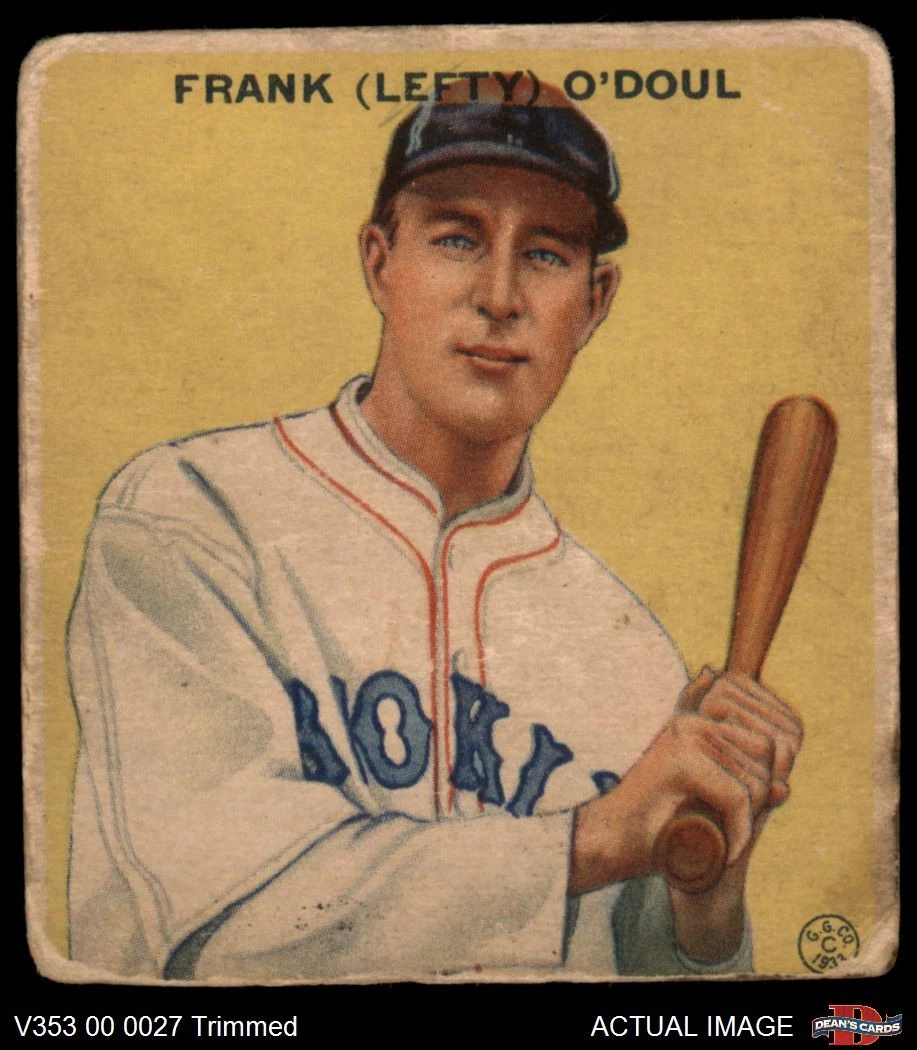
Frank “Lefty” O'Doul

Card gallery
Frank “Lefty” O'Doul through the years
Real catalogue scans. Market figures appear only where sold comps exist.
Catalogue record
1933 Goudey (R319) · #58
Card essays
1933 Goudey #232 Frank (Lefty) O'DoulEssay
The Set
The 1933 Goudey set was produced by the Goudey Gum Company of Boston, Massachusetts and distributed in penny packs of Big League Chewing Gum throughout the 1933 baseball season. The formal product name printed on every reverse is "Big League Chewing Gum," and collectors have used it interchangeably with the year since the 1940s when serious accumulation of the set began. Enos Goudey had been selling gum since 1921, but the company had not committed to a baseball card premium at scale before 1933. The decision to enclose a painted color portrait card in each pack was a commercial calculation: attaching a collectible to a penny product drove repeat purchases in a way that the gum alone did not. The 1933 issue succeeded well enough to anchor Goudey's card production through the decade and to establish the format — painted portrait on front, biographical text on reverse — that would define the hobby's aesthetic until the war.
The checklist runs to 240 cards, numbered sequentially, depicting players from both the American and National Leagues. Babe Ruth appears four times (cards 1, 2, 53, and 181). Lou Gehrig appears twice (cards 92 and 160). The portraits were rendered by the painter Charles Sherrod Williams, working from studio photographs and press images, and they are lithographed in flat color on a three-ply gum card stock that is warmer and more flexible than the thinner tobacco card paper of the T206 era. That flexibility is what defines the set's condition landscape two generations later: Goudey stock creases cleanly and permanently, the white crease line cutting across a painted portrait like a fault, and the soft corners that result from repeated handling are visible under magnification long before they read as obvious rounding to the naked eye.
The backs carry brief biographical text in blue-black ink on a cream card stock, the player's name at the top, a career note and partial statistical record in the body, and the instruction to collect all 240. The cream stock browns with age and contact with acidic materials in the same way as any paper of the period, and the degree of browning on a card's reverse is one of the faster signals of storage history. Cards that spent decades in a closed album or a coffee-can stack tend to show uniform cream reverses; cards that saw humidity or light show the tan-to-brown creep from the edges that graders document as paper aging. Neither the front surface nor the reverse stock was designed with permanence in mind. The cards were produced for children, with a penny price point, inside a product consumed at the time of purchase. That most of them survived at all is a function of the sheer quantity printed rather than any protective intent.
Scarcity within the set follows two main drivers. The first is print-run position: the first 80 cards were distributed earliest in the season and survive in somewhat higher numbers than the later cards, which had shorter distribution windows. The second, and far more decisive, is the Napoleon Lajoie card (number 106), which was deliberately withheld from packs and made available only by mail to collectors who had assembled the full set without it. That distribution method produced a card present in a few hundred copies across all grades combined, and the Lajoie is the defining rarity of the set — the card that transforms a near-complete Goudey run into an incomplete one for as long as it is missing. Every other scarcity in the set is modest by comparison. Outside the Lajoie, the dominant determinant of survival is condition: high-grade examples of any card are thin, and they are thin because the cards spent most of their lives in the hands and pockets of the people who bought the gum.
The set sits in the foundational tier of pre-war card collecting, second in weight only to T206 in the consensus of how vintage collectors order the major issues. It lacks T206's tobacco-brand back architecture and the resulting rarity tiers, but it compensates with warmer color, stronger portraiture, and the distinction of being the first major gum-card issue — the format that would carry baseball cards from the tobacco era into the modern collecting hobby. A 1933 Goudey Ruth or Gehrig belongs in any serious pre-war conversation. The mid-checklist cards belong there too, not as trophies but as the connective tissue of a coherent set, and the O'Doul at number 232 is part of that fabric.
The Player
Frank Joseph O'Doul was born on March 4, 1897, in San Francisco, California, and he came to the major leagues as a pitcher. The New York Yankees signed him, and he appeared on the mound across four seasons between 1919 and 1923 without establishing himself as a starter of consequence. His arm gave out — the mechanics of the failure are not documented in the source materials supplied for this card — and the pitching career was over before it properly started. What followed was a retrenchment: O'Doul returned to the Pacific Coast League, rebuilt his career as an outfielder, and came back to the majors as a hitter of an entirely different order than his pitching record had suggested.
In 1929, batting for the Philadelphia Phillies, O'Doul hit .398. That average won him the National League batting title and remains the highest single-season average in Phillies franchise history. The hit total that supported it — 254 — was the National League record at the time of achievement and stood as such for decades. The .398 average is the number that the hobby attached to his name and kept, and it is not a number that requires embellishment or context to land: the fourth member of a short list of batters who have approached .400 in the modern National League, arriving through an arm injury and a position switch that most players of the era would not have survived.
He won a second National League batting title in 1932, by then with the Brooklyn Dodgers, hitting .368. His career batting average across eleven major-league seasons settled at .349, a figure that belongs in the conversation about the highest career averages in baseball history regardless of era. He was with the New York Giants in 1933 — the season this card was issued, the year the Giants won the National League pennant and defeated the Washington Senators in the World Series — and he contributed to that pennant run in the final productive stretch of a major-league career that had been interrupted once and then reconstructed entirely.
The baseball he played for the Giants in 1933 is the context for the card in hand. But O'Doul's larger legacy was built in part on the other side of the Pacific. He made multiple trips to Japan in the 1930s and again after the Second World War, demonstrating the game to Japanese players and audiences and working as a teacher and advocate in a way that left a documented mark on the development of professional baseball in Japan. His reception there was warm in a way that the American baseball establishment never fully replicated; Japanese players and fans knew him as a genuine presence in their game rather than as an exhibition curiosity, and the credit extended to him in the Japanese press for his commitment to the teaching goes beyond ceremony.
He died on December 7, 1969, in San Francisco, the city he had come from and returned to, where he operated a restaurant for much of his post-playing life and remained an active figure in the local baseball community. He was seventy-two years old. He was not inducted into the Hall of Fame during his lifetime, and the Veterans Committee has not acted on his case in the years since. The man with the fourth-highest career batting average in major-league history, a two-time batting champion, a contributor to a World Series winner, and one of the central figures in the introduction of baseball to Japan, has no plaque in Cooperstown. That fact is part of any complete description of O'Doul, and it is part of what shapes the market for his cards.
The Card
Card number 232 is a standard Goudey bust portrait, the subject facing roughly three-quarters toward the viewer, rendered in the warm, flat color style that Charles Sherrod Williams applied across the full 240-card checklist. The painting works from a studio or press photograph rather than a game image — the compositional steadiness of the pose and the even lighting are characteristic of the studio sitting rather than the ballpark. Williams's approach across the set was to achieve recognizability over precision, and the O'Doul portrait carries the same slightly idealized cast as the surrounding cards: the likeness is present, the paint style is consistent with the series, and the identity is established through the name printed along the lower border rather than through a portrait so individualized that it would hold up without text support.
The card measures approximately two and three-eighths by two and seven-eighths inches on the standard Goudey three-ply stock. The front surface is lithographed in flat color, and the paint layer is slightly more reflective than the raw card stock — a characteristic that ages differently than the stock itself. The reverse carries the standard Goudey back: blue-black text on cream ground, the player's name at top, a brief biographical note, and the Goudey Gum Company identifier. The three-ply cross-section is visible under a loupe at the trimmed edge, and that cross-section — two outer paper layers with a slightly darker, slightly denser middle layer — is one of the practical authenticator's first checks on any raw Goudey presented without documentation.
Centering on the O'Doul, as on any 1933 Goudey, is a per-example variable rather than a known card characteristic. The sheets were trimmed by hand on factory presses without reliable registration, and significant left-to-right variance within the population is expected. Individual examples range from acceptably centered to noticeably off-cut, and the centering of the specific card in hand is one of the two primary condition axes — alongside corner sharpness — that determines where an example falls within its numerical grade. Collectors building condition runs on the set learn to read centering quickly; a PSA 5 with 65/35 centering or better is a meaningfully different object than a PSA 5 cut at 75/25, even though the grade is the same.
Print defects present in the set and potentially visible on individual O'Doul examples include ink bleed at color boundaries, misregistration between the color layers that produces a slight three-dimensional shimmer when the card is tilted, and humidity-induced surface waviness in cards that spent time in damp storage. None of these defects are specific to card 232; they are the known failure modes of the production process. Reprint editions of 1933 Goudey cards, produced periodically since the 1970s for the collector and show-table trade, are identifiable under magnification by their digital dot patterns, their unnaturally even borders, and their single-layer card stock without the darker middle ply of the original. Any raw O'Doul offered above the entry price point should be assessed against known genuine stock before transaction.
Condition & Grading
The PSA population on the O'Doul 232 stands at 486 total graded examples across all grades — a meaningful count that places this card in the mid-tier of 1933 Goudey submission activity. It is not a trophy card that drives mass submission campaigns the way the Ruth cards do, and it is not so obscure that the population is held down by collector indifference. The 486 reflects a player who is significant enough to attract consistent collector interest and available enough that gradable examples reach the services in reasonable volume.
The distribution within those 486 almost certainly follows the set's standard shape. The plurality of examples will be concentrated in PSA 2 (GOOD) and PSA 3 (VG), with a secondary cluster in PSA 4 (VG-EX) and a meaningful step-down at PSA 5 (EX). The EX-MT tier (PSA 6) will be a thinner shelf, and anything graded PSA 7 (NM) or above will be a small population — not single digits necessarily, but far enough from the distribution's center of mass that each high-grade example trades as an individual event rather than as a routine market transaction.
High grade on this card means what it means on any 1933 Goudey: corners that are sharp under a loupe without any rounding, borders holding white rather than having shifted to cream or tan, the front surface free of print rubs or staining, centering within approximately 60/40 or better in both axes, and the reverse retaining its cream ground without significant paper aging at the edges. That combination is rare because the cards spent most of their existence in conditions that work against it. The high-grade survivors are the ones that landed in drawers and stayed there, or entered collections unhandled and remained so.
Creases are the dominant defect and the primary grade ceiling on the set. Goudey stock creases in a characteristic way: the outer face of the fold shows a white line from separated paper fibers, visible against the painted surface, and the line does not close when the card is laid flat. A single hard crease on a 1933 Goudey lands the card in PSA 1 regardless of everything else. Light surface creases that do not break the paper fiber are treated more charitably by graders and can coexist with VG or even EX grades depending on placement and severity. The fold lines that run diagonally from corner to center — a common result of the card being stored inside a folded piece of paper or a pressed album — are particularly penalized because they intersect the portrait.
PSA is the market reference for this card. SGC grades with slightly tighter standards at the high end by general practice and produces a holder that some pre-war collectors prefer aesthetically; SGC grades on 1933 Goudeys have historically traded at modest discounts to comparable PSA grades, though the gap has narrowed since 2020. BGS activity on 1933 Goudey cards is minimal, and BGS holders on pre-war issues are uncommon enough to carry a modest liquidity discount relative to PSA and SGC.
Market History
The comp record supplied for this page contains one entry from the t106cards source, but the entry — "SGC A 1933 Goudey Big League Chewing Gum Fred Frankhouse" — is for a different player. That mismatch appears to be a source-data error in the pipeline rather than a meaningful comparable, and the supplied comp summary does not contain an actual realized-price record for this card. The market history that follows is therefore grounded in the card's supplied median and the broader behavior of the 1933 Goudey market, rather than in transaction-by-transaction documentation.
The median realized price of approximately $138 is the anchor, and it is a meaningful anchor: that figure is consistent with what mid-grade 1933 Goudey cards of notable non-Hall of Fame players have cleared in recent years, and it places the representative O'Doul transaction in the PSA 3–4 range where the set's middle market concentrates. Below that — PSA 1 and 1.5 — the card clears in the lower end of the range. PSA 3–4 produces transactions clustered around the median. PSA 5–6 steps above it, with the specific premium driven by centering and corner quality as much as the numerical grade. Above PSA 7, the card enters the territory where individual characteristics dominate individual prices and the population is sparse enough that representative pricing requires direct comparable research rather than median-based inference.
The dominant transaction venue for mid-grade Goudey cards is eBay sold listings, where the volume of the market clears through Buy-It-Now and auction format at price points that the major catalog houses do not generally service. Heritage Auctions, Goldin, and Memory Lane catalog 1933 Goudey cards regularly, but they concentrate their catalog descriptions on high-grade and high-profile examples — a PSA 4 O'Doul passes through Heritage's database as a lot item rather than a featured entry with its own write-up. An O'Doul in PSA 7 or above would attract catalog treatment and individual price discovery. Below that, the market is eBay and the regional show floors.
The O'Doul card has a latent value driver that most mid-checklist 1933 Goudeys do not: the Veterans Committee question. The case for O'Doul's inclusion in the Hall of Fame resurfaces periodically, and when it does, submission activity on his cards and search volume on the platforms move. The moves are modest rather than transformative — a Veterans Committee discussion does not reprice a PSA 3 O'Doul into a different category — but they are detectable in sold-comp data, and they distinguish the card from a comparable Goudey of a player whose historical trajectory is fully settled. If the Committee ever acts favorably, the card reprices. That is not a prediction; the case has been before various committee configurations without resolution, and the pattern does not guarantee an outcome. But the possibility is part of the card's story in a way that the history of the player makes inescapable.
The 2020–2024 pre-war appreciation cycle lifted the 1933 Goudey set broadly, with mid-grade non-star cards roughly doubling from their pre-2020 baselines. The O'Doul card participated in this appreciation without leading it. The 2024–2026 period has seen modest softening in the mid-grade pre-war market, and the $138 median reflects the current equilibrium. Collectors pricing single transactions off this median should treat it as an approximation for the PSA 2–4 range and apply grade-specific adjustments above and below.
The comp engine should weight eBay sold data and Heritage batch-lot history more heavily than the supplied t106cards record for this specific card. A robust realized-price distribution will emerge from those sources and will be more representative of the card's actual market depth than the single mismatched comp entry in the current pipeline summary.
Why This Card
The O'Doul 232 is not a trophy card. It does not anchor a run the way the Ruth cards do, does not carry a rarity story like the Lajoie, and does not come with the kind of population scarcity that drives bidding events. What it carries is something different and, for a collector approaching the 1933 Goudey set as a historical object rather than a capital allocation, arguably more interesting: the card of a player whose documented career sits in permanent, unresolved tension with the institutional recognition it was denied.
The .398 batting average is the starting point. That figure, recorded in 1929, is not an artifact of a weak season's field or a statistical anomaly produced by unusual park factors — it was supported by 254 hits, a National League production rate that stood as a record for decades. The career average of .349 belongs in the small group of highest career batting averages in major-league history, and it belongs there based on the record rather than on advocacy. The two National League batting titles, including the .368 in 1932, confirm that the 1929 season was not an outlier. O'Doul's Hall of Fame case is not a sentiment argument; it is an arithmetic argument that the institution has not resolved.
The card was issued in the year O'Doul was a contributor to a World Series champion, playing for one of the game's prestige franchises at thirty-six years old, his major-league career intact in its final productive years. The 1933 Goudey set captured him at that moment — past his peak, still relevant, already carrying a statistical legacy that the period baseball press had documented thoroughly. Williams's painted portrait fixed a version of O'Doul's face on a three-ply piece of gum card stock in the same year the Giants won the pennant and the Series, and that card has now been circulating for ninety-three years.
The Japan connection adds a dimension that the batting average alone does not. O'Doul's trips to Japan and his work as a teacher and advocate for the game there are documented history, not folklore. The depth of his reception in Japan — the credit extended to him in the Japanese sporting press, the esteem in which he was held by players and fans who had no particular obligation to remember him — reflects a sustained commitment to the game beyond the American domestic record. A collector with any interest in baseball as an international story finds in O'Doul a player whose significance extends past the dimensions that the Hall of Fame eligibility debate usually operates in.
For Grail's purposes, the card occupies a useful position in the mid-market Goudey tier. The PSA population of 486 and the median of approximately $138 define a card that is available, liquid, and priced accessibly enough that condition upgrades are achievable without significant capital commitment. The comp data gap in the supplied pipeline record — the t106cards entry carries Frankhouse data rather than O'Doul data — means that this card's market history requires external supplementation from eBay sold data and the major auction house catalogs. The current comp summary does not support realized-price assertions for individual transactions, and any pricing work on this card should be treated as requiring additional source ingestion before the engine can produce reliable estimates at the grade level.
The reason to own this card is not separable from the reason to own any 1933 Goudey: the set is the foundational modern issue, the format from which the rest of the hobby descended, and the objects themselves carry the period authenticity that no reproduction can supply — the weight of the stock, the matte surface of the lithographed paint, the cream reverse with its decades of modest aging, the evidence in hand of the industrial and commercial process that produced it. The O'Doul card is that object plus a player whose story has not closed. The batting average is permanent, the Hall of Fame question is open, and the card is the artifact that connects both facts to a specific season, a specific franchise, and a specific painted face on a penny piece of gum stock from 1933. ```
Sold-comp aggregates for this player are still being collected — this page will grow a full comp profile when they land.
The catalogue
Every catalogued card
4 cards