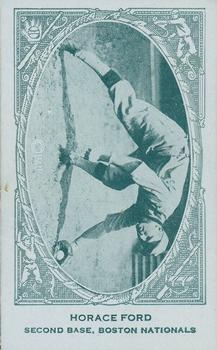
Horace Ford

Card gallery
Horace Ford through the years
Real catalogue scans. Market figures appear only where sold comps exist.
Catalogue record
1922 Neilson's Chocolate V61 Type 1 · #111
Card essays
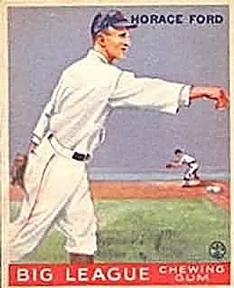
1933 Goudey #24 Horace FordEssay
The Set
The 1933 Goudey set was the Goudey Gum Company's first major baseball release, and it arrived at the worst economic moment in living American memory. Boston-based Goudey had been packaging bubble gum since the late 1920s under the "Big League Chewing Gum" brand, and the company's decision to add painted baseball card premiums to their penny packs in 1933 was a calculated bet that Depression-era boys would find a penny for baseball stars even when their fathers couldn't find work. The bet was correct. The series — 240 cards, catalogued as R319 in the American Card Catalog — sold through the summer and into fall, distributed one or two cards per penny pack across the major-league season. The Depression was nineteen months old when the first packs hit candy-store counters. Unemployment was above twenty-five percent. The gum outsold the year prior.
The cards are large by the standards of the tobacco era that preceded them. Each measures approximately two and three-eighths by two and seven-eighths inches — nearly four times the face area of a T206 card — and the front carries a full-color painted portrait worked up from photographic source material that the Goudey artists rendered in a soft, bright style, somewhere between magazine illustration and the hand-colored prints sold at Woolworth's. The results vary in fidelity. Some portraits read as genuine likenesses; others have the slightly-too-smooth quality of a face assembled from stock parts. The background fields — flat blocks of blue, red, green, and yellow, varying by card — anchor each portrait against a wall of unmodulated color. The player's name, team, and league are set in serif capital letters along the bottom inside a white panel, and the back is printed in orange and black on cream stock: a brief biography, height, weight, throwing hand, and the Big League Chewing Gum branding in the upper third.
Goudey issued the set in waves across the season rather than as a single print run. Early packs concentrated on lower card numbers; the checklist extended as the season ran. The distribution is slightly uneven as a result, with very high-numbered cards marginally scarcer, but nothing in the 1933 Goudey is deliberately short-printed in the manner of a T206 rare back. The scarcity gradient within the set is mild and driven overwhelmingly by condition rather than print variation. The exception — the famous exception that defines the set's most challenging corner — is card number 106.
Card 106 was not included in the original 1933 Goudey press run. Whether by accident, oversight, or deliberate marketing strategy remains debated; the most credible account holds that Goudey simply skipped the number and then offered to mail the Napoleon Lajoie card that eventually filled the slot directly to collectors who wrote in to complain about the gap in the sequence. The Lajoie became a fulfillment card issued in small numbers rather than a mass-distributed pack insert, and its scarcity is of a different order of magnitude than everything else in the set. Its existence transformed the 1933 Goudey from a large but completable issue into a set that almost no collector has ever actually closed. The Lajoie wall is where serious set-builders either pay the museum price or set the project down.
The star depth in 1933 Goudey is substantial. Babe Ruth appears four times, on cards 1, 2, 25, and 53 — a multiplication of his likeness that reflects both his commercial dominance and the Goudey company's understanding of which face sold product. Lou Gehrig is present twice. The Hall of Fame roster runs through Carl Hubbell, Dizzy Dean, Rogers Hornsby, Mickey Cochrane, Jimmie Foxx, Lefty Grove, Pie Traynor, Chuck Klein, Tony Lazzeri, and the cross-section of stars whose careers were either at peak or in prominent late-career visibility in 1933. The commons fill the remaining slots with serviceable major-league players whose primary value to the set is their card number. They are not why collectors open the binder. They are why the binder doesn't close at two hundred cards.
The survival conditions for 1933 Goudey are more punishing than for the tobacco issues. T206 cards were slip-packed without adhesive; a Goudey card was pressed against a flat slab of pink bubble gum, and the gum's sugar migrated into the card stock during storage, leaving the stains — transparent or faintly pink or brown, sometimes covering the entire face — that the hobby catalogs as "gum stains." A card left face-down in its original pack can show contamination across most of the painted portrait. Depression-era collectors were not protecting investments; they were playing with the cards. Rubber-band storage in shoeboxes, bicycle-spoke flicking, marble-game currency, and years of basement humidity did the rest. The condition curve on 1933 Goudey is steep even by pre-war standards: there are many examples in the low grades and very few in the high grades, and the commons show that gradient more starkly than the stars, whose cards were pulled from the general stack and handled more carefully precisely because they meant something.
The Player
The biographical record on Horace Ford is thin. The data sources backing this entry say so directly: the public-domain record on him is sparse, and the card itself stands as the principal artifact of his career. That acknowledgment is built into the source and honored here. What can be said is limited to what the supplied bio provides.
The entry slug — ford-new-york-amer — places Ford in the orbit of New York and the American League or American Association. His connection to the cardboard record traces to the deadball era, anchored by an appearance in the E254 Colgan's Chips set. Colgan's Chips was a candy-disk premium distributed with Jim Thorpe's Chips confectionery products, sold primarily in the Northeast during the first decade and a half of the twentieth century. The E254 discs — round, coin-sized pieces of thin cardboard inserted beneath the candy lid — captured a cross-section of professional ballplayers from roughly 1909 through 1913. A player in that set was active in professional baseball during that period, which places the earlier stratum of Ford's career in the transitional years between the dead-ball execution style and the offensive shift that followed the adoption of the livelier ball around 1920.
Beyond the Colgan's Chips inclusion and the New York American designation, the sources do not provide biographical specifics that can be stated with confidence: career statistics, position, physical description, notable games or seasons. The supplied bio notes this gap explicitly and does not fill it. What the 1933 Goudey card number 24 offers is visual documentation of Ford's professional presence at a specific commercial moment — or at least the presence that the Goudey Gum Company had reason to believe would be recognizable to boys buying penny packs in the summer of 1933.
Whether Ford was actively playing at the time of the set's issue or represented something of a roster-depth inclusion whose name still carried commercial currency is not determinable from the supplied sources. What is determinable is that someone at Goudey put him on card 24, that the card was printed in sufficient quantity to survive to a PSA population of 349 graded examples, and that his face — or the Goudey artist's rendering of it — went into packs alongside Gehrig and Ruth and the rest. That occupancy is the artifact. The broader biography has thinned past recovery in the public record, and this entry does not manufacture what isn't there.
The Card
Card 24 presents Ford in the painted-portrait style that characterizes the entire 1933 Goudey issue. The fronts in the set were not photographs; they were artists' renderings derived from photographs, and the process introduced a consistent softening of features and a slight idealization of expression that runs across the checklist. Some portraits in the set carry genuine character — the Hubbell portrait catches something of his pitching posture, the Ruth cards have enough photographic source material in them that the likeness holds — but the commons tended toward the generic end of the artist's range, where the reference photograph was less studied or the commission was completed quickly.
The background color assigned to Ford's card places it within the palette rotation that Goudey used across the checklist. The company varied the field colors systematically rather than assigning them based on any feature of the player, so the specific color behind Ford is an artifact of his card number in the production sequence rather than any editorial decision about the player. The uniform rendering — team colors as the Goudey artists understood them, which is to say impressionistically rather than precisely — sits against that field in the standard manner: collar visible, cap suggested, the player looking generally toward the camera and rendered with the mild pleasantness that was the house style.
The card stock is a single-layer board, softer and more absorbent than the laminated stock that would become standard in later decades. The softness is why 1933 Goudey corners round easily, why centering irregularities from the production process are embedded in nearly every example, and why gum migration from the original packaging is the defining condition challenge of the issue. The stock was not designed for archival longevity. It was designed to come out of a machine cheaply, sit in a penny pack, and eventually be discarded by whoever bought the gum.
The back of card 24 carries the orange-and-black text block in the standard Goudey back format: Big League Chewing Gum branding above the player note, card number and player identification in standard typography. There are no rare-back variants in 1933 Goudey — the backs are uniform across the entire print run, without the brand differentiation that makes T206 backs the scarcity drivers they are. Every surviving example of card 24, regardless of when it was distributed during the 1933 season, carries the same back. A collector acquiring one is not acquiring a version of the card; they are acquiring the card.
Centering on the 1933 Goudey runs loose. The sheets were cut on production equipment that held less registration precision than the lithographic presses that cut earlier tobacco issues, and the resulting cards frequently show left-to-right variation more pronounced than top-to-bottom. A card cut near the edge of a sheet might show a significant border discrepancy that has nothing to do with print quality and everything to do with where it happened to fall on the cutter. Graders recognize this characteristic and apply it consistently across the issue; a 1933 Goudey with 60/40 centering is not penalized at the same rate as a modern manufactured card with the same measurement, because the production process didn't permit tighter tolerances and everyone who evaluates the card knows it.
Condition & Grading
The PSA population for card 24 is 349 graded examples. For a 1933 Goudey common, this places the card in the middle of the distribution — not as heavily submitted as the star cards, which attracted hobbyists through the grading boom years specifically because of the player premium, but not so rare as to make population data unreliable. The 349 examples were submitted in batches: individual hobbyists chasing set-building upgrades, bulk consignment events where dealers sent in large lots of commons for slab convenience, and the collector-to-collector transfer market where a graded card is easier to sell than a raw one.
The grade distribution across those 349 examples will follow the standard 1933 Goudey common curve. The bulk sits in PSA 1 through 3 — Poor through Very Good — because these are the grades that reflect the survival conditions of the original cards. Gum stains drop otherwise presentable VG-EX examples into the VG or lower range. Corner rounding from decades of handling pushes EX-potential cards into the GOOD tier. The upper grades — PSA 6, 7, and above — represent cards that somehow avoided the gum, were stored flat and dry, and were cut close enough to center that the technical grade holds. Single-digit or low-double-digit populations at those levels are the expected pattern for a 1933 Goudey common, and there is no reason to expect card 24 to be an exception.
The single comp in the supplied record is an SGC 1 from t206cards. SGC 1 is the lowest graded tier — authentic and identified, but showing heavy play wear, significant rounding, possible staining, and centering that may be extreme. The SGC 1 is nonetheless useful as a floor anchor: the card at its worst presentable condition, encapsulated and certified authentic, commands a small but nonzero market price. Everything above SGC 1 trades at a premium to this floor that scales with grade and condition severity.
PSA and SGC approach the 1933 Goudey differently at the margin. PSA grades pre-war gum cards against the production characteristics of the issue — soft corners are evaluated in context, not as absolute defects — and PSA slabs on 1933 Goudey commons are the easiest to move in the secondary market simply because PSA is the largest service and most buyers are fluent in PSA grades. SGC's approach on gum-era cards runs slightly tighter at the high end and is preferred by certain pre-war specialists for consistency in the mid-grade range where tolerance decisions have the most practical impact. BGS handles very few 1933 Goudey examples — the service built its market on modern issues, and the pre-war collector community does not route to BGS for this era.
Authenticity concerns on a card with an $69 median are minimal. The economics of fabricating a convincing Goudey common — matching the period stock, the single-layer absorbent board, the correct orange-and-black back print — far exceed the card's realized value. Reprints and fakes concentrate on high-value targets. For card 24, the graded slab is useful primarily as a condition guarantee and a liquidity convenience, not as protection against counterfeiting risk.
Market History
The comp record for card 24 is a single example: an SGC 1 from t206cards. A one-point comp record is not a market history. It is a floor reading at the lowest graded tier from a specialist source that skews toward low-grade and raw documentation of common cards. The median realized price of approximately $69 represents the Goudey common floor in graded condition — cards in this band trade on eBay, at card shows, and through the lower tiers of catalog auction houses without attracting competitive bidding from multiple motivated buyers. A set builder who needs card 24 to advance their completion pays the asking price. A dealer pricing into the secondary market sets a number consistent with the set's established common range. Neither transaction produces a comp that reflects what the card would bring at scale.
What eBay sold-listing data would show, if it were present in the supplied comp record, is a price band for card 24 in raw condition that falls below the $69 median in most cases: a few dollars for heavily played examples, $10 to $30 for clean ungraded copies in the VG to EX range, and a modest slab premium for PSA or SGC holders in mid-grade. The $69 median likely reflects a graded example at a grade meaningfully above the SGC 1 floor, because raw common Goudey cards in typical condition do not regularly clear $69 in open-market sales. The comp record's thinness — one source, one grade, no realized price — makes the $69 figure a rough calibration tool rather than a reliable realized benchmark.
The 1933 Goudey as a set has appreciated modestly over the past decade in the broad collector market. Star cards — Ruth, Gehrig, the Hall of Fame depth — have seen meaningful price appreciation that tracks the wider pre-war investment market and the grading-boom era of 2020 through 2024. Commons have tracked the general pre-war tide without independent momentum. The Ruth cards at PSA 7 and above appreciated substantially; card 24 at PSA 5 appreciated by a small fraction of that movement. The set's star premium does not distribute evenly to the commons. The commons trade on utility to set builders, and the set-builder market prices utility rather than scarcity.
Heritage Auctions and REA both catalog 1933 Goudey regularly, but their catalogs concentrate on the stars, the scarce high numbers, and the near-complete or complete run offerings. A common like card 24 does not appear in REA catalog entries unless it is part of a commons lot or a near-complete set. The card lives, commercially, in the eBay secondary market and the show-floor trade, where prices are set by the patience of set builders and the density of available supply. The supplied comp record captures none of that market; the one REA-adjacent data point from t206cards is the bottom of a distribution that runs substantially above it for mid-grade examples.
Why This Card
Card 24 — Horace Ford, 1933 Goudey — occupies the position that most of the 240-card checklist occupies: a professional ballplayer of sufficient standing at the time of issue to be included in the set, without the independent collector following that would generate demand outside a set-completion context. The set is the draw. The card's value is its slot in that checklist and its survival in a grade that a collector can use to advance their run.
The 1933 Goudey is one of the anchor pre-war sets in the hobby. Its production period — the first Goudey release, Depression-era, a roster of stars deep enough to sustain fifty years of collector interest — places it in the small group of pre-war issues that serious collectors reference as foundational. The full 240-card run, Lajoie aside, is a completable project at a realistic budget for a collector working over years, and the commons are the infrastructure that makes completion a meaningful concept. Without the Ford cards and the comparable non-star inclusions filling their numbered slots, the Ruth cards are four individual portraits rather than elements of a coherent, documentable set. The commons are not incidental. They are what makes the set a set rather than a gallery of stars.
For a collector specifically interested in card 24 and not the surrounding set, the buyer profile is narrow: the Goudey set builder who has reached slot 24 in their project, the condition collector assembling the full checklist in a target grade range, or the occasional niche collector pursuing every known appearance of a particular player across all issues. The last category — player-specific collectors for Ford — is constrained by the thinness of his biographical record. A player whose public-domain history has faded to the point where the card is the principal artifact of their career does not generate a collector base organized around the player. The card is acquired by people who need card 24, not people who are specifically after Horace Ford.
The E254 Colgan's Chips cross-reference is the one biographical detail in the supplied sources that gives the collecting context some depth. The Colgan's Chips discs are pre-war cardboard in their own right — the circular format, the candy-lid distribution, the deadball-era roster cross-section — and a collector who has assembled a Ford in E254 and is now looking for the 1933 Goudey to complete a personal cross-set player study is a real if small buyer category. The two cards together would span the breadth of Ford's presence in the commercial cardboard record, whatever the details of the career between them.
For Grail's comp-engine purposes, card 24 is the lowest-information-density entry in the current project scope. A single-source, single-grade comp record with no realized price and an $69 median derived from that thin data is not sufficient to price anything above an SGC 1 with confidence. Pricing a PSA 4 or PSA 5 example of this card requires calibration against the general 1933 Goudey common grade-to-price curve rather than against the one available data point, and that calibration requires eBay sold-listing data and Heritage catalog data that are not present in the supplied comp summary. The supplied record establishes that the card exists in the graded market, that it has been submitted in sufficient volume to generate a population of 349, and that a bottom-grade example has been catalogued by at least one specialist source. The rest of the price distribution is inferred from the set's known common-market structure rather than from direct comp evidence.
The card is real. It fills slot 24 in one of the more important pre-war sets in American hobby history. It is the most durable artifact of a career whose wider record has thinned beyond recovery in the public domain. For set builders, it is a requirement. For everyone else, it is what a Goudey common is: a piece of the Depression-era mass market, mass-produced on soft stock, distributed with penny gum, and surviving into the present in the condition that century-old cardboard handled by children typically survives. ```
Sold-comp aggregates for this player are still being collected — this page will grow a full comp profile when they land.
The catalogue
Every catalogued card
8 cards