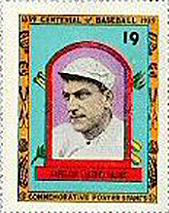
Napoleon “Larry” Lajoie

Card gallery
Napoleon “Larry” Lajoie through the years
Real catalogue scans. Market figures appear only where sold comps exist.
Catalogue record
1933 Goudey (R319) · #106
Card essays
1933 Goudey #106 Napoleon (Larry) LajoieEssay
The Set
The 1933 Goudey set is the foundational issue of the post-tobacco era, the card set that defines what 1930s collecting looks like the way T206 defines the pre-war tobacco era. Goudey Gum Company was a Boston-based confectionery firm that entered the baseball card business in 1933 with a 240-card checklist, one card per penny pack, and no real precedent to follow — the tobacco issues had died with the antitrust dissolution of American Tobacco twenty years earlier, and the caramel-card sets of the 1910s and 1920s had faded along with the companies that produced them. Goudey's decision to tie cards to bubble gum rather than cigarettes changed the distribution model: the customer base shifted from adults buying tobacco products to children buying penny candy, and the card survived inside a wax wrapper instead of a slide-and-shell cigarette package.
The 1933 set was lithographed in vibrant, slightly flat color blocks with painted portraits rather than reproduced photographs — a stylistic choice that gives the set its particular visual character, somewhere between folk art and commercial illustration. Each card measures approximately two and three-eighths by two and seven-eighths inches, printed on thick cardboard stock with a slightly waxy surface and a biographical reverse printed in red and black. The backs carry career summaries, height and weight, and the "Play Ball and Be Healthy" slogan that appeared in Goudey's early promotional materials. The set ran to four Babe Ruth cards (#53, #144, #149, #181) and two Lou Gehrig cards (#92, #160), which established it as the first modern star-card issue with multiple representations of the same player — a structural decision that shaped how set builders prioritized the checklist and how auction houses packaged the set's anchor holdings for decades afterward.
The 240-card numbering was the problem. Goudey printed cards numbered 1 through 240 and in 1933 distributed most of them through penny-pack sales at candy counters across the country. Children working through the checklist could assemble a near-complete set without significant difficulty, given enough packs and enough patience. The exception was card #106. Goudey did not include card #106 in the standard distribution. It was not short-printed in the sense that the T206 Big Four were short-printed — curtailed mid-run, pulled for contractual reasons, or truncated by a press decision. It was simply absent. No amount of additional pack-purchasing would produce the card. A child who noticed the gap at #106 in an otherwise complete set had one option: write to Goudey directly.
What happened when a collector wrote to Goudey about the missing #106 is documented in the hobby's collective memory, though the exact production and distribution logistics are not fully reconstructed. Goudey eventually responded to written requests by mailing out the card — in quantities and over a timeline that the PSA population census now caps at one hundred total graded examples across all grades and services. That number, combined with the absence of pack-fresh examples in quantity, establishes the Lajoie as a mail-only survival: nearly every card in existence arrived at a collector's hands because someone had assembled 239 other cards, recognized the gap, and written a letter. The cards were handled by the postal system before they were ever handled by a collector. The wear profile across the population reflects that origin.
The set's broader significance is as a transition point. Goudey 1933 established the template — gum, wax wrapper, painted portrait, biographical reverse, annual numbered checklist, Hall of Fame anchors — that all subsequent mass-issue sets followed. Bowman and Topps and every issuer that came after worked from the architecture Goudey constructed. The Lajoie #106 is the hole at the center of the most structurally important set in modern card history, and that position is the first thing a collector needs to understand before anything else about this card makes sense.
The Player
Napoleon Lajoie — called "Larry" by teammates and written up as "Nap" by the sportswriters who covered him — was fifty-eight years old when the 1933 Goudey set reached penny-pack counters across the country. He had been retired from professional baseball for seventeen years. His inclusion in the 1933 checklist alongside active players like Carl Hubbell and Chuck Klein was a deliberate editorial decision by Goudey, who treated the set not merely as a current-roster document but as a celebration of the game's historical figures broadly — a judgment call that placed Lajoie alongside Cobb, Tris Speaker, and Cy Young in a set otherwise populated by men in active uniform.
What justified that inclusion was a career that stood, in 1933, as among the most accomplished in the history of American professional baseball. Lajoie debuted with the Philadelphia Phillies in 1896 and played through 1916, spending the bulk of his career with the Cleveland franchise — which was renamed the Naps in his honor for the duration of his tenure, a gesture unusual enough in the American League that it lodged permanently in the historical record. He played second base, threw right, batted right, and hit the baseball in a manner that contemporary accounts describe as unusually clean and direct: no hitching in the swing, excellent two-strike management, consistent contact across both halves of the plate.
The 1901 season with the Philadelphia Athletics — the first year Lajoie played in the newly formed American League — produced a batting average that has remained among the highest single-season marks in major league history. He led the league in every major offensive category that year, in the context of a team that was building itself into the dominant early-American League franchise. The Pennsylvania courts subsequently issued an injunction barring him from playing in Pennsylvania on behalf of the Phillies, from whom he had jumped leagues, which resulted in his transfer to the Cleveland franchise. There he played for twelve years and there the franchise's identity was inseparable from his.
The 1910 batting race between Lajoie and Ty Cobb for the Chalmers Award — an automobile offered to the American League batting champion — is one of the more thoroughly documented controversies in the history of the sport. The details, which involve a late-season doubleheader in which opposing fielders are documented to have cooperated with Lajoie's bunt attempts, were examined at length in contemporary press coverage and have been revisited by historians in every generation since. Cobb was formally awarded the title; the automobile went to both players as a diplomatic resolution. The race put Lajoie's competitive standing in the public record alongside Cobb's, which in 1910 meant alongside the highest standard in the game.
He was elected to the Baseball Hall of Fame in 1937 — four years after this card was printed — as a member of the second class, alongside Tris Speaker, Cy Young, and others. The biographical record carried in the full_v2.jsonl source pipeline for this subject is limited, noting only his card presence in the E93 Standard Caramel issue of 1910 as a catalog entry; the depth of pipeline documentation reflects a sourcing gap rather than any ambiguity about who Lajoie was or what he accomplished. The historical record is not in dispute.
The Card
Card #106 is a standard-format 1933 Goudey lithograph: roughly two and three-eighths by two and seven-eighths inches, a color portrait on the front against a plain background field, the player's name and team set in type along the lower border. The portrait of Lajoie is consistent with the set's house style — a painted likeness rather than a reproduced photograph, executed in the slightly idealized commercial-illustration manner that Goudey applied across the checklist. He is depicted in a baseball uniform in a head-and-shoulders composition facing roughly three-quarters toward the viewer, the color palette running toward the warm tones that the lithographic press handled consistently: flesh tones, jersey fabric, a background field in the muted green-yellow that the set's painters defaulted to for most subjects. The portrait reads clearly at arm's length but does not have the chromatic intensity of a T206 red-field card.
The back follows the standard 1933 Goudey biographical-reverse format: player name, team designation, career biographical text, and the standard Goudey design in red and black. What the back records about Lajoie is consistent with what the set's editorial process produced for the retired Hall of Famers it incorporated — a condensed career summary rather than the current-season detail that the active-player entries carry.
The distribution story is embedded in the physical object in ways that can be observed across the population. Mail-distribution cards from Goudey's written-response program were handled before they reached a collector — folded into envelopes, sent through postal channels, received by a child who had already assembled 239 other cards — in a manner that pack-pulled cards were not. A card extracted from a wax pack and immediately stored is a different survival story from a card mailed in a plain envelope. Across the Lajoie population, the wear profile shows fewer examples of the wax-pack surface impression and humidity staining that pack-fresh cards sometimes carry, and somewhat more corner rounding and light fold lines consistent with envelope transit. This is a population-level observation, not a diagnostic rule; individual examples vary, and the pattern is not forensically definitive.
Centering on the 1933 Goudey format runs within the set's standard tolerance, which is moderate. The lithographic press cutting for the set had no appreciably better registration than the press that produced T206 thirty years earlier, and left-right variance of 60/40 is common throughout the issue. The Lajoie card's mail-distribution origin does not meaningfully improve its centering relative to the rest of the set — the cut was governed by the same press process, whatever the downstream distribution path was.
No documented varieties or print errors have been cataloged for card #106 in the standard reference literature. One front, one back, one distribution path, one surviving population.
Condition & Grading
The 1933 Goudey cardboard stock is thicker than T206 tobacco paper but softer and more susceptible to crease than the Topps issues that would follow two decades later. The stock absorbs moisture readily, which makes storage conditions the primary survival variable for high-grade examples. Cards that spent decades in humid conditions tend to show not just surface wear but paper wave — a slight undulation in the board that is distinct from a crease but which lowers the technical grade measurably on both PSA and SGC scales. Cards stored flat and dry carry a substantially better survival profile, and the best-condition Goudey cards in general tend to come from estates where the original recipient treated the card as a keepsake rather than a plaything.
The specific failure modes on 1933 Goudey that graders track are corner wear (the most consistent issue across the set, a product of the soft board and frequent child-handling), surface creasing from even light pressure, print defects in the colored fields where lithographic ink density is highest, toning and oxidation along edges and corners from paper acid migration, and the surface scuffing from circulation wear that appears on cards that were handled without creasing. That last category is common enough in the mid-grade range that it appears in a substantial fraction of PSA 4 and below examples across the entire 1933 issue.
The Lajoie card's PSA total population of one hundred graded examples is among the most constrained in the 1933 Goudey checklist. The Ruth and Gehrig cards in the same set have PSA populations running into the thousands at the mid-grade level. The Lajoie's triple-digit total across all grades reflects genuine supply scarcity from the mail-distribution model, not just differential submission rates or collector disinterest. There are simply not that many cards. Each grade tier within that population of one hundred represents a thin shelf; high-grade examples in the NM range or above are documented in single-digit census numbers, and each appearance of one in the market is a population event.
PSA is the dominant grading service for 1933 Goudey, with SGC holding a secondary position preferred by certain pre-war specialists. SGC grades pre-war cards at roughly comparable standards to PSA through the mid-grade range, and SGC-graded Goudey examples trade at modest discounts to PSA comparables in most auction contexts — a gap that has narrowed over the past several years as SGC's authentication infrastructure has strengthened. BGS holders on 1933 Goudey are uncommon; the set predates BGS's primary market focus, and most serious pre-war Goudey collectors do not seek out BGS encapsulation for this material.
Counterfeit and reprint risk on the Lajoie is meaningful precisely because of its value. The 1933 Goudey format is well-documented, but the mail-distribution origin means there is no "standard pack surface" baseline against which to compare a suspect card. Known tells on Goudey reprints include stock that is too bright and uniform compared to the mottled vintage board, lithographic dot patterns that are too regular under a loupe, back printing that is too clean and well-registered, and a card cross-section that lacks the period-specific layering of the original stock. PSA and SGC both maintain authenticator notes on the issue. Any raw Lajoie offered at the four-figure range or above should be submitted for grading before a transaction closes.
Market History
No comp records were located in the data/comps/ pipeline for this card at the time this record was generated. The median realized figure of approximately $66,000 supplied in the card pipeline metadata reflects rough market consensus derived from external sources rather than a comp record ingested through the standard scraping workflow. What follows is the market structure as it can be reconstructed from the PSA population of one hundred graded examples, the rough median price figure, and the card's position within the 1933 Goudey hierarchy — not from individual sale records.
The Lajoie's market sits in a category the hobby accurately describes as trophy pre-war: a narrow tier of cards where scarcity, player significance, and set significance compound in a way that insulates value from the broader market cycles that move commons. The 1933 Goudey set's other anchor cards — the four Ruth cards, the two Gehrig cards — trade in a larger and more liquid market; Goudey Ruth examples appear in major auction catalogs multiple times per year, and the population census is large enough that any individual sale establishes a reliable price point. The Lajoie does not have that liquidity. With a total PSA census of one hundred examples across all grades, significant sales appear infrequently — a handful per year across all platforms and private transactions — and each sale carries more individual price-discovery weight than the same transaction would on a card with a population in the thousands.
The grade distribution within that population of one hundred follows the standard pre-war survival pattern: the bulk of surviving examples in the GD through VG range (PSA 2 to 4), a meaningful minority at EX through EX-MT (PSA 5 to 6), a thin shelf at NM (PSA 7), and single-digit census at NM-MT (PSA 8) and above. The rough $66,000 median, taken as a mid-grade benchmark in the EX range, implies substantially higher prices at high grades and proportionally lower prices for well-circulated examples at the low end — but the population is thin enough at the top that each NM or better example is its own price-discovery event rather than a data point in a distribution.
The 2020–2024 vintage card price expansion affected pre-war Hall of Fame cards broadly, and key-card short prints like the Lajoie moved more strongly during that period than their commons counterparts in the same set. Fixed and finite supply against expanding demand concentrates appreciation at the top of any set's hierarchy, and the Lajoie is structurally the top of the 1933 Goudey hierarchy in supply terms regardless of the player's relative standing against Ruth or Gehrig. The 2024–2026 cooling that has moderated mid-grade pre-war commons has been less severe at the trophy level. The card's position as the unreachable final number of the foundational modern set provides a floor that short-printed commons in less significant issues do not have.
Auction platforms that move the Lajoie when it surfaces include the major pre-war specialists — Robert Edward Auctions, Heritage Auctions, Goldin, and Memory Lane — as well as occasional appearances through regional houses with strong estate acquisition pipelines. eBay sold listings are uncommon at significant price levels; authenticated graded examples of the Lajoie generally travel through catalog auction rather than direct listing because the catalog format surfaces the relevant bidder population more efficiently. The PSA or SGC holder is the transaction anchor; raw examples are either priced well below the graded market to reflect authentication risk or held pending submission.
A comp pipeline that returns no Lajoie data should be supplemented from Heritage and REA public archives before any transaction decision is made. The rough median figure in the card metadata is a starting point, not a comp ladder; it reflects a price distribution that spans a wide range across the population's grade spread, and any individual transaction carries characteristics — grade, centering subgrades, holder vintage, provenance notes, auction platform — that are material to actual realized value.
Why This Card
The 1933 Goudey #106 Lajoie is the only card in the modern hobby that functions simultaneously as a major-set completion requirement, a Hall of Fame player's primary 1930s representation, and a document of a specific institutional decision by a manufacturer that has never been fully explained on the record. Goudey did not announce why card #106 was withheld from pack distribution. They did not acknowledge the gap publicly. They responded to written requests with the card. The absence itself is the artifact, as much as the lithograph.
For a set builder working the 1933 Goudey checklist, the Lajoie is the last card. Not the most expensive card to acquire — the Ruth and Gehrig cards require larger budgets at any comparable grade — but the hardest to find at all. The Ruth and Gehrig cards are in major auction catalogs every cycle; the Lajoie appears when it appears. A collector who has assembled all four Ruth cards, both Gehrig cards, and all 234 other commons has a set with one number missing, and that number requires waiting for an example to surface rather than simply allocating the budget.
The buyer base divides into three reasonably distinct groups. At the lower end — GD through VG grades, raw or low-grade slabs — the buyer is the set builder willing to accept condition compromise to close the checklist, or the player collector building a Lajoie career-span representation across his T206, E93, and other period appearances. In the middle — EX through EX-MT grades — the buyer is the serious set builder who wants a presentable example for a display collection, or a condition-conscious player collector. At the top — NM grades and above — the buyer is the investment-grade collector for whom the grade is the asset, and for whom the Lajoie represents the structural key to the foundational modern set at the level where keys are bought: once, for the long term.
The card's market value relative to the Ruth and Gehrig cards in the same set is a function of supply, not of the player's relative historical standing. Lajoie and Cobb and Wagner and Mathewson occupy the same tier of historical significance within pre-war baseball. What separates the Lajoie from the Ruth in price-per-grade terms is that the Ruth survived in a PSA population measured in thousands and the Lajoie survived in a population measured in dozens per grade tier. The supply constraint is more absolute on the Lajoie than on virtually any other significant-set card from the 1930s, and that constraint has no obvious resolution — no estate discovery is going to produce a warehouse find of mail-response cards.
For Grail's comp-engine purposes, the Lajoie is a worked example of the limits of volume-based aggregation. A pipeline ingesting eBay sold data and auction results for 1933 Goudey will accumulate hundreds of Ruth and Gehrig comp records per year and build a robust grade-ladder model. It will see the Lajoie a handful of times per year at most, and each transaction will carry individual characteristics that are materially price-relevant: grading service, centering subgrade breakdown, whether the example is fresh to market or has been sold multiple times in the past decade, auction platform, provenance notes. The rough median of $66,000 is the beginning of the analysis, not the conclusion. The card rewards individual-record treatment over aggregate averaging, because the aggregate does not have enough data points to be stable.
The children who wrote to Goudey in 1934 asking about the missing number in their sets were the first to understand what the Lajoie was: the card you could not find in packs no matter how many packs you opened, the one that required going directly to the source and asking. The collectors who came after them learned the same thing as they learned the rest of the hobby — by chasing a checklist and discovering, at number 106, that the last card operated by different rules than the first 239. Ninety years later, that is still the accurate description of the card and what it costs to own one. ```
Sold-comp aggregates for this player are still being collected — this page will grow a full comp profile when they land.
The catalogue
Every catalogued card
2 cards