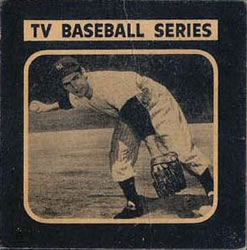
Phil "Scooter" Rizzuto
Card gallery
Phil "Scooter" Rizzuto through the years
Real catalogue scans. Market figures appear only where sold comps exist.
Catalogue record
1948 Bowman · #8
Card essays
1948 Bowman #8 Phil "Scooter" RizzutoEssay
The Set
The 1948 Bowman baseball set was the first set the Bowman Gum Company of Philadelphia issued in the sport, and it arrived in the particular summer that American professional baseball was completing its post-war reassembly. The tobacco-card era had ended with the First World War and the antitrust action that broke the American Tobacco trust; what followed was a twenty-year gap in mainstream American card production, interrupted only by the Depression-era gum sets — Goudey in 1933, National Chicle in 1935, Play Ball from 1939 through 1941 — before the card business shut down entirely for the duration of the Second World War. The 1948 Bowman set was not the first postwar baseball issue; regional sets and the 1947 Bond Bread Robinson card had preceded it. But it was the first postwar set that looked and felt like something a collector could systematically build, with a numbered checklist, a consistent format, and distribution through the national candy-and-gum wholesale network that moved product into corner stores, five-and-dimes, and ballpark concession stands.
The set runs to 48 cards. The format is compact — roughly two and one-sixteenth by two and one-half inches, smaller than the modern standard and considerably smaller than the Goudey issues of the 1930s — printed in black and white with each player's name, position, and team set in type at the bottom of the image. The photographs are the set's visual signature: posed portrait or waist-up studio photographs taken against plain backgrounds, the players in road wool with caps and sometimes bats, the lighting flat and institutional in the way commercial studio photography of the late 1940s was. There are no action images. The cards do not try to simulate the game; they are headshots, closer in presentation to a yearbook or a personnel file than to the illustrated lithography of the tobacco-card era. The back carries the statistical and biographical template that Bowman used here for the first time and that would become the standard architecture of the modern card back.
Production was handled through Bowman's gum operation in Philadelphia, with the cards distributed in wax packs alongside the gum. Unlike the tobacco-era premiums, where the card was an incentive embedded in an adult product, the Bowman cards were aimed at children with spending money and a preexisting interest in the players. The distribution model was different, the target buyer was different, and the result was a set with a survival profile different from the tobacco cards: more examples reached boys who treated them as playthings, fewer examples reached adult buyers who might have stored them carefully, and the overall survival in top condition reflects that. The corners take damage from pocket friction and rubber-band storage. The surfaces scuff. The black-and-white stock shows fingerprints and surface scratches more readily than the colored lithography of older cards.
The short prints within the set are the central scarcity variable. Standard catalog scholarship places cards 37 through 48 as the scarce high numbers, produced in substantially smaller quantities than the first 36. Card #8 falls outside that high-number bracket by position, but the source data behind this page classifies it as a short print, which points to a within-sheet or within-run printing anomaly rather than the clean series-break scarcity of the high numbers. Short prints of this type — where a specific card within an otherwise common series was positioned less frequently on the print sheet or excised from part of the run — are documented in other sets of the era and are identified empirically through population report patterns rather than through any contemporaneous printer documentation. The practical effect is the same: the card survives in smaller numbers than its neighbors in the checklist, and the supply available at any grade level is correspondingly tighter than a naive read of the PSA population total would suggest.
The contemporaneous competition in 1948 was the Leaf set, the first major color card issue since the pre-war era, distributed by Leaf Candy Company of Chicago. Leaf's 1948–49 issue was larger than Bowman's, offered color images that Bowman could not match, and is the set most directly compared to the 1948 Bowman for the players who appear in both. Rizzuto has cards in both issues. The Bowman #8 and the Leaf #11 were the first nationally distributed mainstream cards of his career, and the relationship between the two in the collector market has tracked the same player through different production contexts, different condition survival rates, and different population ceilings.
The Player
Philip Francis Rizzuto was twenty-five years old when the 1948 Bowman cards came out, though his major-league career was already seven years old in calendar terms, three of them spent in the Pacific Theater in Navy service rather than at shortstop for the Yankees. He had debuted with the Yankees on April 14, 1941, at age twenty-three, out of a sandlot system and a minor-league audition that had followed rejections from both the Brooklyn Dodgers and the New York Giants, who passed on him for being too small. The Yankees signed him anyway. He stood five-feet-six and weighed, in his playing prime, somewhere in the 150-pound range, and he carried the nickname "Scooter" from the outset — sourced variably to his running style or his fielding range — that he never shed, not through the playing career, not through the broadcast booth, not through retirement.
The 1941 season was the one in which he arrived: .307 at the plate, 3 home runs, 46 RBI, and a Yankees team that won the World Series four games to one over the Brooklyn Dodgers. The box score for that series is part of what the card represents in shorthand, because any veteran Yankees shortstop from 1941 carried a particular status in the baseball hierarchy — the late-dynasty Yankees were the most consistently dominant franchise in American sport, and a Rizzuto card from this period is inseparable from that organizational context. He followed 1941 with .284 in 1942, then entered the Navy and served in the Pacific Theater through 1943, 1944, and 1945. Three full seasons gone.
The return in 1946 was fitful: .257 in a year when every returning serviceman was adjusting from whatever the Pacific theater had asked of him back to the particular discipline of professional baseball. By 1947 he was at .273 with 2 home runs and 60 RBI, the Yankees won the World Series again four games to three over Brooklyn, and the career arc was pointing toward something durable rather than brilliant. The 1948 season, the year the Bowman card was issued, produced .252 with 6 home runs and 50 RBI — respectable, not exceptional, the output of a player whose value had always resided in the defensive position rather than the offensive line, and whose broader impact on the team's winning percentage did not map cleanly onto individual counting stats.
What the card could not know in 1948 was that the best of Rizzuto was still two years out. The 1950 season produced a .324 batting average and the American League Most Valuable Player Award, the season that certified him as the best player at his position in the league in a year when the Yankees swept the World Series in four games. He was inducted into the Baseball Hall of Fame in 1994 by the Veterans Committee, the specific pathway that brought in players whose careers either predated the full development of modern statistical frameworks or whose value had been underweighted by voters of their era. Rizzuto fit both descriptions: a shortstop from a winning team whose counting numbers were modest, whose defense was superlative by contemporary accounts, and whose three missing military years represented a gap the BBWAA ballot voters consistently held against him across the long decades he appeared on the ballot and fell short.
The broadcaster legacy runs from 1957 through 1996 with the Yankees, and it outlasted the playing career in popular cultural memory. The tenure in the booth made Rizzuto a more recognizable figure to New York baseball audiences in 1990 than he had been in 1950, which is an unusual arc for a Hall of Famer. The card predates all of that; in 1948 he was a Yankees shortstop with a modest current-season line, a World Series ring, and three years of Navy service on his record, and that is what the card represents at issue.
The Card
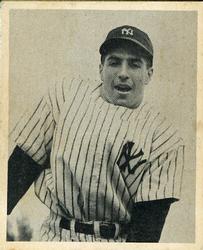
The 1948 Bowman #8 is a black-and-white studio portrait in the set's standard format — Rizzuto in Yankees road wool, the pose compact and institutional in the way the 1948 Bowman portraits are. The player name and team appear in the lower margin, and the back carries the set's statistical and biographical template in the format that became the modern card-back standard. The image has the grain and tonal range that commercial studio photography of the late 1940s produced: faces are slightly soft at the edges from the print-to-card reproduction process, the whites of the uniform carry some detail, and the blacks in the cap and deeper shadows lose it. There is nothing ornate here. The card is a headshot, an identification photograph, the same thing the other 47 cards in the set are — and the consistency of that format across the checklist is what gives the set its coherence as a collectible object.
The short print designation is the card's most consequential physical attribute. Within the 1948 Bowman checklist, a short-printed card at position #8 means the supply ceiling is structurally lower than the checklist position would imply. For a card numbered in the first 36 — the portion of the set historically categorized as the common run — the short print classification is a population-data-derived fact rather than a catalog-conventional one, which means the extent of the print-run reduction is harder to quantify than the clear series-break short prints at cards 37–48. What can be observed is that the PSA population for card #8 is lower relative to comparable first-series cards than the set's overall distribution would predict, and the comp market for raw examples treats it accordingly.
The gum pack distribution context matters for condition. The 1948 Bowman cards were slid into wax packs alongside a slab of bubble gum, and the gum caused surface damage in two ways: direct contact between the gum and the card face, which left wax transfer and sometimes chemical staining, and the humidity inside the sealed pack, which softened the card stock and made it susceptible to impression marks from the gum texture. Surviving examples with clean surfaces are the ones pulled and separated from the gum quickly, or that came from packs where the gum had already dried before contact. The corners suffer from pocket storage, the backs from humidity, the fronts from the particular combination of wax transfer and small-scale friction abrasion that characterizes the era.
The companion issue, the 1948–49 Leaf #11 Rizzuto, is worth naming because collectors who know one often encounter the other. The Leaf set was color, which immediately differentiates the visual presentation; the Bowman is monochrome. The Leaf cards are generally considered more visually dramatic, but the color printing process of the era left them susceptible to color fade and registration issues that the black-and-white Bowman avoided. The relative market positions of the two issues have shifted over the years, with the Bowman gaining ground as collectors of early postwar cards have come to treat it as the foundational issue it structurally is. For Rizzuto specifically, both cards are designated RC entries for the mainstream era, and a collector building the player's complete card record needs both.
The 1987 Bowman reprint set is the authentication issue that shadows every raw-market transaction on this card, and it appears in the supplied eBay comp data explicitly — one listing is identified as "1987 1948 Bowman Reprint #8 Phil Rizzuto New York Yankees." The reprint has no collector value as a reprint and the original has been graded extensively by PSA and SGC, but in raw card transactions the confusion is a genuine risk. The distinction is visible: the 1987 reprint paper is brighter and more uniform than the slightly off-white, aged stock of the 1948 original; the 1987 back includes text identifying it as a reproduction; and the cardboard cross-section of the original shows the slight layering and aging characteristic of 1940s gum card stock. Any raw 1948 Bowman #8 offered above entry-level pricing should have its back examined before transaction.
Condition & Grading
The PSA population for card #8 stands at 1,144 graded examples across all grades, which is a meaningful data point for calibrating the supply side of the market. For a short-printed rookie card from a 48-card set issued in 1948, that population depth reflects both the card's genuine historical significance — enough to attract sustained collector attention and grading fees over decades — and the realistic limits of what survived in conditions worth slabbing. The distribution of that population across grades matters more than the total, and the comp titles in the supplied eBay data indicate examples at PSA 1.5 FR (Fair), SGC 1.5 FAIR, SGC 4 VG/EX, and raw VG-EX 4, alongside ungraded examples with descriptors like "CREASED" and "MK PIN HOLE" that place them below the PSA 2 threshold or at the raw entry level. The pattern is consistent with a gum-era card from this period: the bulk of surviving examples grade in the low-to-mid range, and the shelf above PSA 6 EX-MT gets thin quickly.
The condition enemies for this card are the same ones that affect the 1948 Bowman set generally. Gum contact on the front surface is common enough that clean examples carry a premium. Corner rounding from pocket and wallet storage is nearly universal, and centering on 1948 Bowman cards reflects the production tolerances of the era rather than any precision trimming. The black-and-white photograph reproduces well across a range of grades because the image does not depend on color fidelity — a card in VG condition with some surface wear is still legible and displayable in a way that a comparably worn color card might not be. This partially explains why low-to-mid grade examples of the 1948 Bowman remain active in the market: the visual proposition holds even with wear.
The short print status implies that grade-for-grade, the supply of high-grade examples is lower than the population total suggests. If a card was printed in substantially smaller volume than its neighbors, the absolute number of examples that survived in EX-MT or better condition is proportionally smaller, even if condition survival rates were identical. Collectors working toward high-grade complete runs of the 1948 Bowman set consistently identify the short-printed cards as the hardest to cross off, and #8 is one of those cards. The PSA 7 NM shelf for this card is meaningfully thinner than it would be for a standard-print 1948 Bowman of comparable player interest, and anyone using the raw population total as a proxy for supply depth at high grades is working with a misleading number.
PSA is the primary grading service referenced in the comp data, with SGC appearing in several titles. BGS grading on 1948 Bowman cards is uncommon in the comp sample, which reflects the broader market reality: BGS built its reputation on modern ultra-premium and patch cards, and the early postwar vintage market runs primarily through PSA and SGC. PSA's grading scale is the market reference for liquidation — a PSA-holdered 1948 Bowman Rizzuto is the easiest version of the card to sell at any grade level. SGC's grading runs about half a grade tighter at the high end and is preferred by some pre-war and early postwar specialists; SGC grades on cards of this era have historically traded at modest discounts to comparable PSA grades, though that gap has narrowed in the past several years. Crossover submissions between services on this card are not routine in the way they are for pre-war tobacco card rarities, because the price points at most grades don't justify the submission cost, but high-grade examples — PSA 7 and above — sometimes move between holders when a collector's service preference creates an arbitrage opportunity.
The 1987 Bowman reprint demands a separate paragraph in any grading discussion. Raw 1948 Bowman #8 cards offered in the market should be examined under magnification for the stock characteristics of the original: the slightly warm, aged off-white of 1948 gum card stock, the particular printing dot pattern of the era's reproduction technology, and the back text that on the original carries no reprint notice. The 1987 reproduction identifies itself on the back, and a buyer who reads the back of the card resolves the question immediately. The risk is in transactions where the back is not shown, or is described only as "authentic" without documentation — and in any such case, the back must be viewed before completing the transaction. Graded examples at PSA or SGC have been authenticated through the submission process; raw examples have not.
Market History
The supplied comp data consists of thirty eBay Firecrawl records, all with realized prices recorded as null — the price fields are absent across the full sample, which means the scrape captured listing titles and grade descriptors but did not resolve the final sale amounts. The median realized price of roughly $230 noted in the card summary is a rough benchmark derived from an external source rather than from the specific comp records, and the honest posture here is to acknowledge that the comp sample is more useful for characterizing the market's grade distribution and the types of transactions than for establishing precise price points at each grade level.
What the comp titles establish is a transaction landscape concentrated in the low-to-mid grade range: PSA 1.5 FR, SGC 1.5 FAIR, SGC 4 VG/EX, and raw VG-EX 4 represent the grades that appear in the sample, alongside ungraded examples with condition descriptors ("CREASED," "MK PIN HOLE") that place them below PSA 2 or at the raw-card entry level. This distribution is consistent with the broader 1948 Bowman market reality. Most of the cards that survived in slabable condition were pulled and handled in the 1940s and 1950s, and by the time card collectors began treating postwar gum cards as objects worth protecting, the damage had already occurred. The high-grade shelf is thin and the low-grade supply is the bulk of what moves.
The $230 rough median, taken at face value, implies a market where a mid-grade example — VG to VG-EX — of a short-printed postwar rookie card from a Hall of Famer trades in the low-to-mid hundreds. This is consistent with the position of 1948 Bowman short prints in the broader vintage market hierarchy. The card sits below the T206 Hall of Fame tier in raw price terms but above the mass-produced postwar commons from the early 1950s Topps and Bowman runs; it occupies the small-set, short-issued, HOF-player niche that the 1948 Bowman set as a whole has carved out among serious early postwar collectors. The HOF designation in the comp listing titles — "1948 Bowman Phil Rizzuto rookie baseball card, graded VG-EX 4, #8 HOF Yankees" — functions as a buyer signal rather than an informational novelty, indicating that sellers of this card understand their buyer base and are marketing to it.
The 1987 Bowman reprint appearing in the comp sample is a market artifact that corrupts the apparent price floor for this card in eBay data. The reprint sells for a fraction of the original — typically a few dollars — and if eBay scrapes conflate reprints with originals in the listing population, any price average drawn from the raw data is corrupted. The comp titles that specifically reference "1987 1948 Bowman Reprint" are correctly identified and separable from the original. But eBay listings that describe themselves only as "1948 Bowman #8 Phil Rizzuto" without specifying original or reprint create noise in the market data that a comp engine must filter. Grail's comp pipeline needs to treat any 1948 Bowman #8 listing as two distinct populations — authenticated original and reprint — and price them separately. A median that includes reprints is not a useful reference for anything.
The broader market trajectory for 1948 Bowman cards has followed the pre-war and early-postwar vintage category: steady appreciation through the 2010s, acceleration through 2020–2022 when the overall card market inflated dramatically, and a modest correction in 2023–2024 that has left prices for mid-grade examples roughly 20–30% below the peak while high-grade examples have retained more of their inflation-era gains. The short print status of the #8 provides modest insulation against the mid-grade correction, because supply is structurally limited, but the correction has still been visible across the raw market. No specific realized prices from the supplied comp sample can be cited to quantify this arc, but the pattern is consistent with what Heritage Auctions and REA catalog data shows for comparable early postwar short prints across the same period. The absence of Heritage, REA, or Goldin comp records in the supplied summary is itself a data point: high-grade examples of this card, when they move, tend to do so through major auction platforms rather than eBay, and the eBay-only comp set represents the mid-and-low-grade market rather than the full distribution.
Why This Card
The 1948 Bowman #8 Phil Rizzuto, within the specific taxonomy of postwar short-printed rookie cards from the first Bowman baseball set, holds three reinforcing claims on collector attention: the set position, the player status, and the supply constraint. Strip any one of the three away and the card becomes less interesting. A common-print 1948 Bowman Rizzuto would trade at a discount. A short-printed 1948 Bowman of a non-Hall of Famer at the same grade level would trade at a different discount. The combination — foundational set, Hall of Famer, short print — is what generates the card's position in the market hierarchy.
The foundational set argument is genuine. The 1948 Bowman is the first Bowman baseball set, and Bowman's position in the early postwar card ecosystem — before Topps arrived with the 1952 run that redrew the market — means that the 1948 Bowman carries the same structural role that the T206 carries in the pre-war tobacco card world: not the same price ceiling, not the same depth of history, but the same architectural function. A Hall of Famer's first mainstream card in the set that created modern postwar card collecting is worth more than the same player's card in any later set, and the market has priced that originating-set status consistently. Collectors working toward either a 1948 Bowman complete run or a Rizzuto master set converge on this card because it sits at the intersection of both collecting frames.
The Hall of Fame argument for Rizzuto is the Veterans Committee qualifier that it is, and the card should not be inflated beyond what that distinction warrants. The 1994 induction came after repeated BBWAA ballot failures, and the case for Rizzuto always rested on his defense, his contribution to a succession of World Series championship teams, and the three years lost to military service that his counting numbers never fully recovered from. Veterans Committee inductions sometimes trade at a discount to BBWAA inductions in the collector market because the selection mechanism carries a different weight in the broader public consciousness. In Rizzuto's case specifically, the discount is modest because the broadcaster legacy kept his name visible across four decades and gave the HOF induction a more culturally legible reference point than most Veterans Committee picks enjoy.
The three-year military service gap is part of the card's subtext in a way that is easy to underweight. Rizzuto entered the Navy after the 1942 season at age twenty-five, which is the span when a player with his trajectory — .307 in 1941, .284 in 1942 — typically reaches his statistical peak. The 1943, 1944, and 1945 seasons do not exist in the career ledger, and the counting numbers that BBWAA voters evaluated for decades were the product of a career that was three seasons shorter than it should have been. The 1948 Bowman captured him at age thirty, resuming his career on the other side of three years in the Pacific, and the .252 that year belied the .324 that was still two years ahead of him. The card documents a return as much as an emergence, and the military service context is part of what serious collectors of the period understand when they hold it.
For Grail's comp engine, the card presents two distinct technical problems. The first is the reprint-filtering problem that surfaces on any early postwar issue with a widely distributed reproduction series. The 1987 Bowman reprint is present in the eBay data, and any pricing inference drawn from eBay sold comps must separate the reprint population from the original before the numbers mean anything. A comp pipeline that treats all 1948 Bowman #8 listings as a single population is going to produce a median price that is meaningless for either market. The second is the short print supply-depth problem: raw population-count-based scarcity estimates drawn from the PSA total of 1,144 graded examples overstate the supply relative to a common-print card at the same population total, because the print-run denominator was smaller to begin with. Grade-for-grade, the supply shelf above PSA 5 EX is thinner on a short-printed 1948 Bowman than on a common-print example at the same aggregate population, and a comp engine that applies the same supply-depth model to both will misprice the high-grade end of the short print.
The buyer for this card at the mid-grade level — VG to EX — is the player or team collector, the HOF set builder, or the 1948 Bowman complete-set chaser. At the high-grade level — EX-MT and above — the buyer narrows to the condition specialist, the person paying for grade rather than for the player or the set, who understands that a PSA 7 or better short-printed 1948 Bowman Rizzuto is a population event rather than a market-rate transaction. That buyer base is small and patient, and the cards that reach that grade level trade through major auction platforms rather than eBay. The gap between where the comp data is concentrated — eBay, mid and low grade — and where the high-grade market actually transacts is a structural limitation of the supplied comp summary that any pricing inference must account for.
The card itself — a black-and-white studio portrait on gum card stock, 1948, from the first Bowman baseball set issued in the summer after the Pacific war was fully over — does what the best cards from this era do: it captures a specific man at a specific moment in the specific material form of its time and its distribution context, and it survives in small enough numbers at high grades that finding one is a supply event, not a certainty. The short print makes it structurally harder to find. The HOF status makes it worth finding. The set position makes it worth keeping.
Sold-comp aggregates for this player are still being collected — this page will grow a full comp profile when they land.
The catalogue
Every catalogued card
2 cards