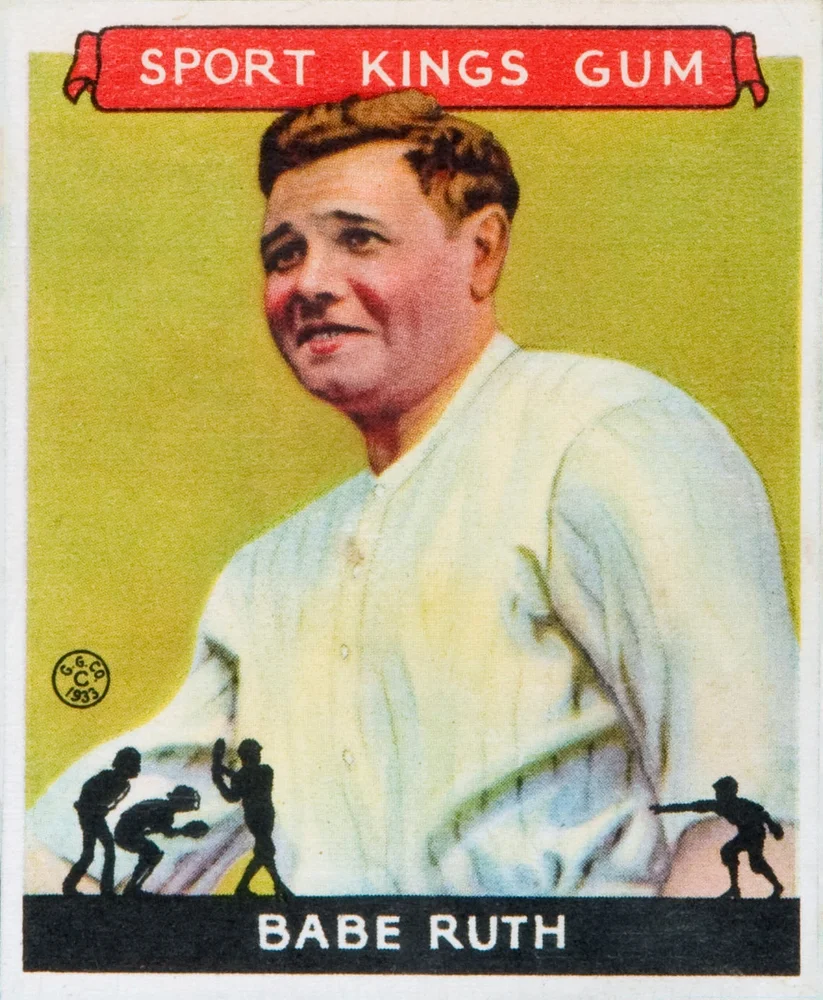
The 1933 Goudey Ruth: Four Cards, One Legend
Most stars in a set get one card. Babe Ruth got four.
The 1933 Goudey set put Ruth on cards #53, #144, #149, and #181. Same player, same set, same year. Four entries in a single checklist. That alone makes the set unusual. What makes it interesting is that the market has never priced the four cards as equals, and the reasons it doesn't are worth understanding before you spend money on any of them.
This is not a story about one card. It is a story about four cards wearing the same name, and why "a 1933 Goudey Ruth" is one of the more misleading phrases a buyer can say out loud.
Why the set matters in the first place
1933 Goudey is one of the foundational gum-card issues. It arrived as the modern baseball card was taking shape: a card sold with a slab of gum, marketed to kids, printed in bright color at a time when most earlier issues were tobacco inserts or duller cabinet-style prints.
A few things make it a cornerstone of the prewar hobby:
- It is large, at 240 cards, and dense with Hall of Famers.
- It carries first or early Goudey appearances of players collectors still chase nearly a century later.
- It is colorful and graphically confident in a way that reads as "trading card" to a modern eye, which earlier issues often don't.
For a lot of collectors, 1933 Goudey is the entry point to serious prewar collecting. It is old enough to feel historic, common enough to actually find, and stacked with names that need no introduction. The set is the destination; the Ruths are the headline.
Four cards, four looks
Goudey did not simply reprint the same image four times. The four Ruth cards differ in pose and in background color, and those differences are most of the reason the market separates them.
Without inventing specifics that vary by reference, the broad strokes collectors rely on:
- #53 and #181 are widely treated as the two "premium" Ruths, anchored by a bold full-color portrait presentation against a strong background. These are the cards most people picture when they imagine the 1933 Goudey Ruth.
- #144 is a yellow-background card that, while still very much a Ruth and very much desirable, has historically sat a notch below the red-background portraits in collector preference.
- #149 shows Ruth in a different pose and is frequently the most affordable of the four in like-for-like condition, the one that lets a budget-minded collector own "a Goudey Ruth" without competing for the marquee numbers.
The takeaway is not the exact color on each card. It is that the four are not interchangeable, and the hobby has spent decades building a settled pecking order among them.
Why some command more than others
If the player is identical, the price gap has to come from somewhere else. It comes from four levers, and they stack.
Color and eye appeal. Prewar buyers pay for presence. A bright, high-contrast background and a clean portrait pose simply photograph better, display better, and feel more like "the" Ruth. The red-background portraits win this contest, and the premium follows the eye.
Pose and recognizability. A card that looks like the canonical image of Ruth carries the iconography. A less familiar pose, even of the same man in the same set, asks the buyer to settle for something that reads as secondary. Markets punish "secondary."
Card number. Numbers matter more than outsiders expect. Certain positions in a set are tied to specific print behaviors and collector conventions, and a card's number becomes part of its identity. When two cards are otherwise close, the one with the more desirable number carries a premium for reasons that are partly historical and partly habit.
Condition rarity. This is the quiet one. Two cards can have similar raw appeal but very different survival curves in high grade. Centering tendencies, print quality, and how a given card weathered eighty-plus years all shape how hard it is to find a clean copy. A card that is merely uncommon in low grade can be genuinely scarce in high grade, and the premium for condition compounds the premium for everything else.
None of these levers acts alone. The expensive Ruths are expensive because color, pose, number, and condition-rarity all point the same direction at once. The cheaper ones lose on one or more of those axes.
The #106 Lajoie aside
You cannot talk about 1933 Goudey for long without the Napoleon Lajoie card, #106, coming up. It is the most famous quirk in the set, and it is useful context for understanding how this issue actually behaved.
The short version: card #106 was not distributed with the rest of the set in 1933. Collectors trying to complete the 240-card run found a hole where #106 should be. Goudey eventually made the Lajoie card available separately to people who wrote in, and it reached the hobby a year later than everything around it.
The result is a card that is structurally scarcer than the rest of the set and carries a story that has nothing to do with the player's on-field stature. Lajoie was a great player, but #106 is coveted because of how it was issued, not because of who is on it.
Why does this matter for the Ruths? Because it is a clean illustration of the set's central lesson: in 1933 Goudey, the card number and the issuing circumstances can matter as much as the name on the front. The Lajoie proves the principle in the extreme. The four Ruths show the same principle operating at smaller scale, where number, pose, and color quietly reorder the value of one identical player.
Why "the Ruth" is the wrong phrase
Here is the practical problem. When a seller says "1933 Goudey Babe Ruth," or a buyer says "I want the Goudey Ruth," the phrase points at four different cards with four different price floors.
That ambiguity is where people get hurt.
- A listing that says "Goudey Ruth" and shows the cheaper number while leaning on the reputation of the expensive one is, at best, sloppy and, at worst, deliberate.
- A buyer who has the premium portrait in their head and pays a premium price for a secondary number has overpaid against the wrong comparison.
- A comp pulled from "1933 Goudey Ruth" sales, without separating the card number, blends four distinct markets into one meaningless average.
Always specify the number. #53, #144, #149, or #181. The number is not a detail. It is the difference between four separate cards that happen to share a face.
What a collector should know before buying one
If you are buying a 1933 Goudey Ruth, treat it as four decisions, not one.
- Decide which card you actually want. The premium portrait numbers and the more affordable numbers are different purchases with different ceilings. Pick on purpose, not by whichever listing surfaces first.
- Comp by number, not by name. Never compare a #149 sale to a #53 asking price. They are not the same card and the market knows it even when the listing pretends otherwise.
- Buy the grade, then the eye appeal. In prewar, two copies at the same grade can look very different. Centering and color hold value on this set. A technically equal card with weak presentation will lag a sharp one.
- Assume authentication is non-negotiable. Ruth is among the most counterfeited and trimmed names in the hobby. On a card this valuable and this old, a reputable holder is not optional, and even then, confirm the specifics match the number you are paying for.
- Read the set, not just the star. The Lajoie story is a reminder that 1933 Goudey rewards collectors who understand how the set was made. The same instinct that flags #106 as special is the one that keeps you from confusing one Ruth for another.
Four cards. One name. The legend is shared. The value is not. The collectors who do well here are the ones who stop saying "the Ruth" and start saying the number.