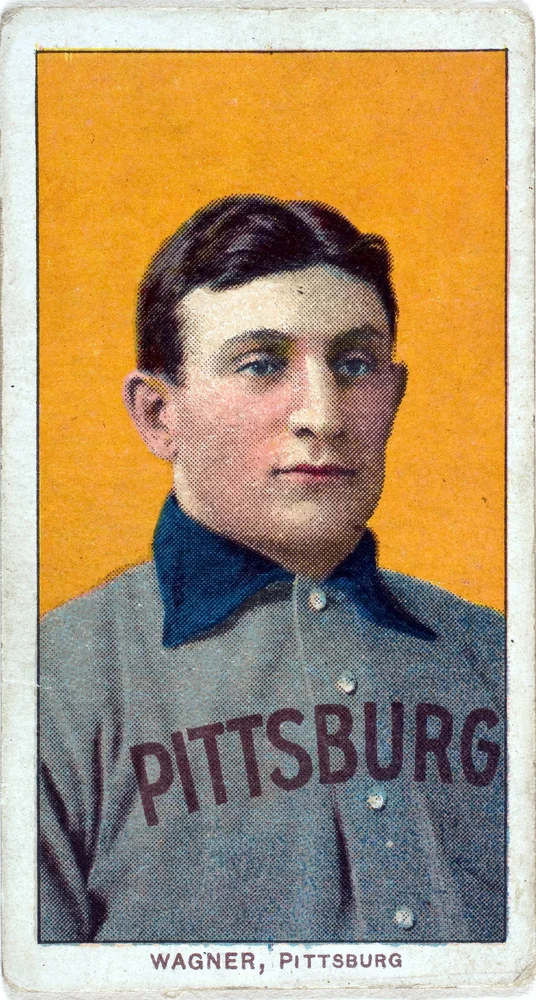
The T206 Back Hierarchy, Explained
Most card sets are organized around the front. You collect the players, the rookies, the stars. The front is the product and the back is a footnote.
T206 inverts this. The fronts are a fixed, finite gallery of around 524 subjects. The backs are where the variation lives, where the scarcity lives, and where most of the money lives.
Two cards can show the identical lithograph of the same player, in the same pose, and differ in value by an order of magnitude. The only difference is the advertisement printed on the reverse.
If you treat T206 as a front set, you will misprice nearly every card you touch. This is how the back hierarchy actually works.
What T206 Actually Is
T206 — the hobby's shorthand from Jefferson Burdick's American Card Catalog — is the white-border tobacco set issued from roughly 1909 to 1911. It is usually called "The Monster" because of its size and its complexity.
The structure has two independent axes:
- The front. A baseball subject: portrait or action pose, player name and team at the bottom, on a white border. This is the part collectors recognize.
- The back. A tobacco brand advertisement. The cards were inserted as stiffeners in cigarette and loose-tobacco packs, and the brand printed on the reverse identifies which product the card promoted.
The cards were not sold. They were packaging. A given front could be paired with the back of whatever brand happened to be running it through the presses, which is why the same player exists with many different backs.
That pairing is not uniform. Some fronts appear with a wide range of backs; some appear with only a few. Some backs are common across hundreds of subjects; some are rare and appear on a narrow slice of the set. The interaction between the two axes is the entire game.
Why the Back Drives the Price
Scarcity in T206 is overwhelmingly a back phenomenon.
The fronts were printed in volume. With the obvious exception of the Honus Wagner — pulled early, scarce for reasons specific to that card — most fronts are not individually rare. You can find the common subjects all day.
The backs are a different story. The advertising back is a direct proxy for how much of a given brand's product was in circulation, and for how long that brand participated in the promotion. A brand that ran cards briefly, or distributed in a smaller region, left behind far fewer surviving cards. That brand's back is rare regardless of which player is on the front.
So the market prices T206 on a multiplier logic:
- The front sets a baseline — a common player is worth little, a Hall of Famer more.
- The back applies a multiplier — common backs near 1x, scarce backs many times that.
A common player with a rare back routinely outsells a star with a common back. Collectors are not paying for the player. They are paying for the survival rate of the advertisement on the reverse.
This is the single most counterintuitive thing about the set, and the most important.
The Common Backs
Two backs account for the bulk of surviving T206 cards:
- Piedmont — the most prevalent back overall, in several typographic varieties (Factory 25, Factory 42, and others).
- Sweet Caporal — the other workhorse, also in multiple factory and print variations.
If you own a random T206 with no prior knowledge, the odds favor one of these two. They are the backs people picture when they picture the set. They are also the backs that make a card a "common" in the trading sense — desirable as a front, but carrying no back premium.
A handful of other backs sit in the moderately common tier — Sovereign, Tolstoi, Cycle, El Principe de Gales, and a few more. These appear often enough to be attainable but carry more presence than the two giants.
For the common backs, the value conversation really is about the front. A Piedmont common is a common. A Piedmont Hall of Famer is a Hall of Famer. The back is doing no heavy lifting.
That is the exception in T206, not the rule.
The Rare Backs
Above the common tier sits the hierarchy that defines serious T206 collecting. These backs are scarce, and several are genuinely rare:
- Old Mill — distributed in the Southern region; scarce, and tied to the Southern Leaguers subset.
- Polar Bear — a loose, scrap-tobacco back; distinctive and far less common than the cigarette brands.
- Lenox — rare, in black and brown print varieties.
- Drum — among the genuinely scarce backs, associated with later printing.
- Uzit, Hindu, Carolina Brights, Broad Leaf, American Beauty, El Principe de Gales (some varieties), and others — each occupying its own rung.
At the very top are the backs that surface only a handful of times and command prices that have nothing to do with the player on the front. These are the cards that move the market when they appear, and the reason a "T206 set" of backs is a lifetime project that most collectors never finish.
The exact ordering shifts at the margins as new cards surface and population data accumulates. But the broad shape is stable: a fat base of Piedmont and Sweet Caporal, a middle band of moderately scarce brands, and a thin, expensive tail of rare backs.
Factory Numbers and Series
The backs carry one more layer most newcomers miss: factory designations and print series.
Many backs include a factory number — "Factory No. 25," "Factory No. 42," "Factory No. 649," and so on — referencing the tax district and plant that produced the tobacco. The same brand name can therefore exist in multiple back variations distinguished only by factory number or typographic detail.
These distinctions matter. Within a single brand:
- One factory variant can be common while another is scarce.
- Print and color varieties (Lenox black vs. brown, the Sweet Caporal print factories) sit at different value tiers.
- Series timing affects which fronts a back was paired with, which is why certain player-back combinations are rarer than either the player or the back alone would suggest.
The set is also organized into print groups across its 1909–1911 run, and not every front was available in every series. The result is that scarcity is a three-way interaction — front, back, and the specific variation of that back — not a simple two-axis lookup.
This is why advanced T206 collecting is, functionally, a cataloging discipline.
What This Means for Authentication
A set whose value lives on the reverse creates an obvious incentive: alter the reverse.
The threats are specific to T206's structure:
- Back swaps and rebacking. A common-back card with damage, or a card with a low-value back, recombined or doctored to present as a scarcer back. Because the front carries the player and the back carries the multiplier, a successful back alteration is a direct value transfer.
- Reprints. Modern reproductions of scarce backs, sometimes married to authentic-looking fronts. The rarer the back, the stronger the incentive to fake it.
- Trimming and re-coloring that primarily target grade, but compound the problem on cards where a scarce back already inflates the stakes.
The practical consequence: a T206 is only as trustworthy as the verification of its back. Print characteristics, ink, paper, factory-number typography, and registration all have to be consistent with the brand and series being claimed. A scarce back is exactly the claim that warrants the most scrutiny, because it is exactly the claim worth faking.
For anyone buying above the common tier, back authentication is not optional diligence. It is the diligence.
Why a "T206 [Player]" Comp Is Meaningless
This is the bottom line, and it is worth being blunt about.
A comp that reads "T206 Ty Cobb, PSA 4" tells you almost nothing. It is missing the variable that determines most of the price.
- T206 Cobb with a Piedmont back is one number.
- The same grade with a scarce back is a different number entirely.
- With one of the genuinely rare Cobb backs, it is a different market altogether.
Pricing a T206 without specifying the back is like pricing a house without specifying the city. You have named the category, not the asset.
Any honest valuation, any defensible comp, any sale that means something, has to name three things: the front, the grade, and the back. Drop the back and the comp is noise — an average across cards that have no business being averaged together.
T206 rewards collectors who internalize this. The front gets you in the door. The back is the set.