The 1952 Topps High Numbers
The 1952 Topps set runs 407 cards. On paper, that is one set. In the market, it is two.
The first three-quarters of the set is collectible, attainable, and historically important. The last quarter — the high numbers, cards #311 through #407 — is where the money concentrates. A set builder can assemble most of 1952 Topps with patience and a moderate budget. Then they hit the back end and the project stops being a hobby and becomes a financial decision.
This split is not an accident of taste. It is the product of how the set was made, sold, and — famously — disposed of.
The set was built in series
1952 Topps did not arrive all at once. Topps released it in series across the year, the standard practice of the era. Cards were printed and distributed in batches, sequenced roughly by number, and pushed out as the baseball season ran its course.
That sequencing is the entire story.
- The low and middle series came out earlier, when interest was high and kids were buying.
- The high-number series (#311–407) came out late, after the season had largely turned over to football and the attention of the buying public had moved on.
By the time the high numbers reached shelves, demand had cooled. Stores that had moved the earlier series briskly found the late series sitting. That seasonal mismatch — product arriving after the audience left — set up everything that followed.
Mantle leads the high series
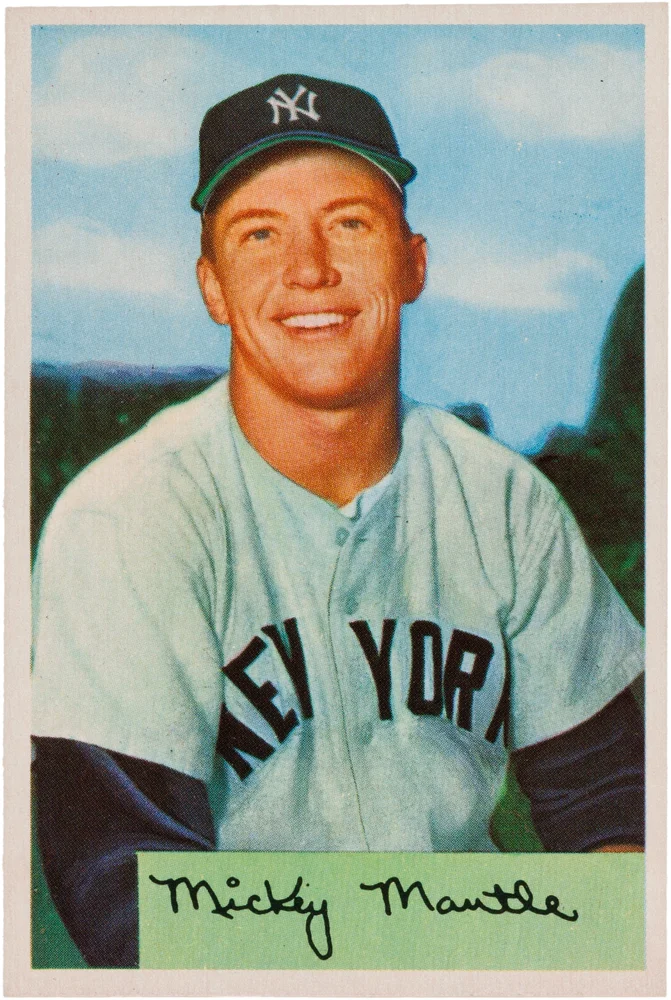
The high-number series opens with card #311: Mickey Mantle.
This is the single most consequential placement in postwar card collecting. The most desirable player of the era leads off the scarcest, hardest-to-find, hardest-to-distribute portion of the set. Demand and scarcity landed on the same card.
It is worth being precise about what the 1952 Topps Mantle is and is not:
- It is not Mantle's rookie card. That distinction belongs to his 1951 Bowman.
- It is the card the hobby treats as his definitive postwar icon — the larger, full-color Topps portrait that became the symbol of the era and, arguably, of the hobby itself.
So the card that carries the most cultural weight is also the card that opens the least-available series. There is no version of 1952 Topps where the key card is easy. The structure guarantees it is hard.
The barge
Then there is the disposal story, which is true and frequently mangled.
Topps did not sell through the high-number series. The late-season cards lingered as unsold inventory for years. By the early 1960s, Topps had a warehouse problem: cases of older, unsold 1952 high numbers taking up space with no realistic resale market. Nobody was clamoring for decade-old baseball cards yet; the vintage hobby as we know it did not exist.
Sy Berger, the Topps executive most associated with the modern baseball card, made the call. The leftover high-number stock was loaded onto a barge and dumped into the Atlantic Ocean.
A few points the market should keep straight:
- This was a routine inventory clearing, not a deliberate scheme to manufacture scarcity. At the time the cards were considered worthless surplus.
- It was the high numbers that went into the ocean — the series that had not sold. The earlier series had largely cleared through normal retail.
- The disposal compounded an existing scarcity rather than creating it from nothing. The high numbers were already underdistributed; the barge removed much of the surviving unsold supply.
The result is a permanent supply asymmetry baked into the set. There is simply less of the back half than the front, and there always will be.
Why the high numbers are condition-scarce, not just scarce
Raw count is only part of it. The deeper issue is condition.
The high numbers are scarce in absolute terms, but they are far scarcer in high grade. The surviving population skews toward played-with, handled, mishandled cardboard — because the cards that did sell went to kids, and the cards that did not sell got dumped. There was no meaningful pipeline of pristine, untouched high numbers set aside by a collector market that did not yet exist.
So the high-grade supply is thin twice over:
- Fewer cards survived overall.
- Of those, a small fraction survived clean.
This is why high-number values do not just sit above the rest of the set — they accelerate as condition climbs. A mid-grade high number is expensive. A high-grade one is a different category of asset entirely. The premium for condition is steeper here than almost anywhere in the set precisely because the supply curve runs out so fast at the top end.
The Mantle is the loudest example of this, but the dynamic applies across the whole #311–407 run. Plenty of ordinary players become genuinely difficult cards once you require a clean copy, simply because they happen to live in the high series.
What this means for set building
This is where collectors have to be honest about what they are actually buying.
Building 1952 Topps is two distinct projects stacked on top of each other:
- Cards #1–310 — a real undertaking, but a tractable one. Available, gradeable, and assemblable over time without a wealth event.
- Cards #311–407 — where the budget goes. The high series alone can cost a large multiple of the entire front of the set, and the condition you accept determines whether the number is large or staggering.
The implication is uncomfortable but clean: in 1952 Topps, the set's value is not spread across 407 cards. It is concentrated in the last 97, and within those, concentrated again in the highest grades, and within those, concentrated once more in a handful of names led by #311.
For a buyer, that forces a strategic question that most sets never ask:
- Chase the set, and accept that the high numbers will dominate your timeline, your budget, and your grade compromises. The front of the set is the warm-up. The back is the actual purchase.
- Chase the key card, buy the Mantle (or a target high number) in the best condition you can justify, and skip the rest. You forgo completion but you own the part of the set that carries the value and the story.
Neither is wrong. But they are genuinely different financial bets, and the structure of the set is what makes them different. In a flat, evenly-distributed set, "build it" and "buy the star" are points on a spectrum. In 1952 Topps, they are two separate decisions.
The takeaway
The 1952 Topps set is the clearest case study in the hobby of how distribution, not just talent or design, sets value.
The cards are well made and historically central, yes. But the reason the back half carries most of the money is mechanical: a late-season series, a cooled-off audience, unsold inventory, and a barge. Mantle at #311 sits at the exact intersection of maximum demand and minimum supply.
Understand that structure and the price behavior stops looking irrational. The set is not overvalued at the back and underpriced at the front. It is priced exactly where the cardboard actually is — which, for the high numbers, is at the bottom of the Atlantic.