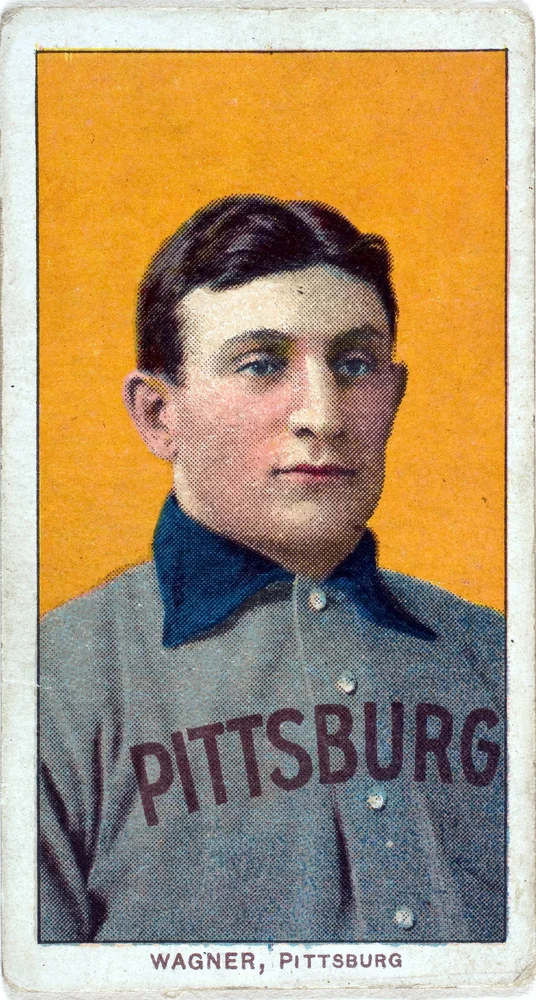
The Honus Wagner Problem
The T206 Honus Wagner is the card everybody knows, including people who do not know cards. That should make it a perfect hobby symbol. In one sense, it does. In another, it has wrecked how non-collectors understand vintage for decades.
The problem is simple: the Wagner is famous enough to represent the hobby, but too weird to represent the market.
It is not normal in supply. It is not normal in pricing behavior. It is not normal in provenance, media coverage, or buyer pool. It is not even normal inside T206, a set already built on layers of scarcity and collector obsession.
So when people point to the Wagner as if it teaches a broad lesson about card value, what it mostly teaches is how fast cardboard stops behaving like cardboard once mythology gets involved.
Scarcity is only the beginning
Yes, the Wagner is scarce. That part is true and obvious. But scarcity alone does not explain the card any more.
There are other scarce cards. There are other prewar icons. There are other pieces of cardboard that matter historically. The Wagner sits above them because scarcity got there first and narrative piled on top of it for more than a century.
It has the right ingredients for permanent hobby folklore:
- a legendary Hall of Famer
- an early tobacco issue
- a short print or withdrawn-card story people can repeat in one sentence
- extremely limited surviving examples
- headline sales big enough for mainstream news
Once those ingredients lock in, the card becomes self-reinforcing. Every new record sale turns the next buyer into part collector, part steward, part headline chaser.
It is not a comp. It is an event
That is the part most people miss.
A normal card sale tells you roughly what the market thought of a given copy in a given condition at a given moment. A Wagner sale often tells you who was in the room, what story surrounded the copy, what provenance attached to it, and how badly one of two or three people wanted to own that exact object.
That is not bad. It is just not the same thing as a clean pricing signal.
Condition still matters. Authenticity matters even more. Provenance matters more than on nearly any other baseball card. Publicity matters. If a copy has a memorable ownership trail or appears in the right venue with the right narrative, it can behave more like art than inventory.
The Wagner does not trade like a card with a price. It trades like an object with a biography.
The grade is not the whole story
People love listing the grade because grades are easy to repeat. But on Wagner, the holder is only part of the sentence.
A low-grade Wagner is still a major object. A presentable but technically rough copy can command absurd attention because so few people will ever have the chance to buy one at all. The market is not choosing between fifty equal copies in adjacent grades. It is reacting to maybe one available example with a highly specific story attached.
That is why trying to draw broad lessons from Wagner pricing usually ends in nonsense. You cannot use a once-in-a-while trophy sale to model the rest of vintage. The thing you are looking at is too distorted by its own fame.
The card changed the hobby's language
This is where the Wagner really matters.
It trained generations of collectors to think in grails. Not just key cards, not just expensive cards, but cards with enough symbolic force that owning them would mean something outside the checklist. The hobby had rare cards before Wagner mythology hardened. After Wagner, every category wanted its own equivalent.
That is why the comparisons never stop:
- "the Wagner of hockey"
- "the Wagner of basketball"
- "the Wagner of postwar"
Most of those comparisons are sloppy. But the impulse behind them is real. Collectors want a card that stands for the whole thing.
The danger of the Wagner lens
The hobby gets warped when too many people look through that lens.
They start chasing only trophies. They assume every expensive card works by the same logic. They flatten the difference between scarcity, condition scarcity, and symbolism. They forget that most serious collecting happens in cards that are obtainable enough to compare, argue over, and actually learn from.
T206 itself suffers from this. People arrive wanting the set of the Wagner and then slowly discover the set is actually better when you stop orbiting just that one card. Cobb portraits, Mathewson, Johnson, Chance, rare backs, tough commons in honest condition, beautiful low-grade examples with clean fronts. That is the real collecting life of T206.
The Wagner sits above it like a lighthouse. Useful for orientation. Useless as a roadmap.
What the Wagner does teach
It teaches that stories compound value.
It teaches that scarcity becomes stronger when the public can repeat the reason in one breath.
It teaches that provenance can matter almost as much as condition once an object becomes famous enough.
And maybe most important, it teaches that the hobby is not a spreadsheet even when people try to make it one. At the very top, the buyers are not just buying scarcity. They are buying meaning.
That is why the Wagner will always matter. Not because it is the best comp. Because it is the cleanest proof that cardboard can leave the card market and enter the myth market.