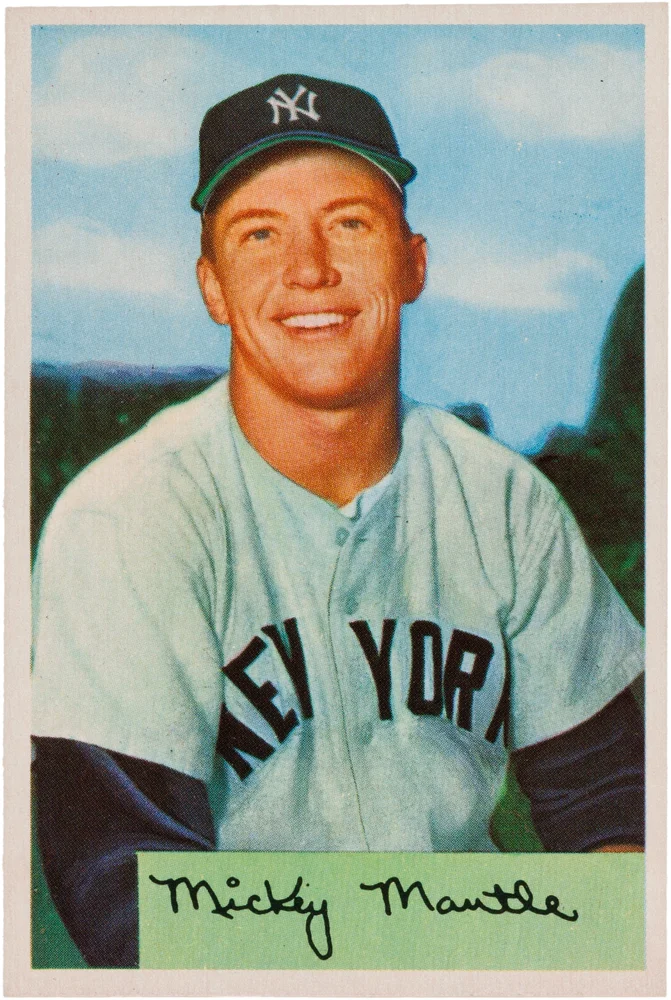
Why a 1952 Mantle Beats a 1951 Bowman
If you want to start an argument in a room full of collectors, ask why the 1952 Topps Mantle so thoroughly outruns the 1951 Bowman Mantle even though Bowman got there first.
The easy answer is "because the hobby picked it." True, but incomplete. The real answer is that the 1952 Topps Mantle became the better symbol.
That matters more than the rookie-card technicality.
Rookie logic only gets you so far
The 1951 Bowman is Mantle's recognized rookie card. Historically, that should be enough. Rookie cards matter. First matters. The hobby usually likes simple chronology when it can get it.
But collectors do not only buy chronology. They buy the card that best carries the player's legend. And the 1952 Topps does that better than the 1951 Bowman, almost unfairly so.
The 1951 Bowman is compact, important, and absolutely worthy. The 1952 Topps is larger, louder, cleaner, more ambitious, and tied to the set that became postwar baseball's flagship myth. One card is first. The other feels inevitable.
The image wins
This part gets underrated because people prefer neat market theories.
The 1952 Topps Mantle is just a better image. The bright portrait, blue sky, facsimile autograph, color block, and oversized canvas make it feel like more than a card. It feels like a poster accidentally shrunk into cardboard.
The 1951 Bowman has charm. The 1952 Topps has command.
That difference matters because Mantle is not just another Hall of Famer. He is a symbolic player. The card that becomes his hobby emblem has to feel larger than life. The 1952 does.
Then the set piled on top
If 1952 Topps were an ordinary issue, maybe the rookie argument holds better. But it is not ordinary. It became the postwar set. Big names, big design, high-number scarcity, hobby lore, and enough visual quality that even commons feel important.
So Mantle did not just land in a good second-year card. He landed in the set the hobby eventually chose as a cornerstone.
That matters because collectors do not buy cards in isolation. They buy ecosystems. The 1952 Mantle benefits from every story the set carries:
- first truly iconic Topps baseball issue
- famous high-number scarcity
- late-series legend
- giant auction-house visibility
The Bowman rookie cannot borrow the same mythology because its set never became the same kind of public monument.
Scarcity worked in the right direction
Card #311 being a sixth-series high number turned out to be the perfect kind of scarcity. Not impossibly rare like a Wagner, not common enough to feel routine, but scarce enough that even the hobby's most famous postwar card still feels like a real event when a strong copy comes up.
That is exactly the right pressure point for a hobby icon. Too rare and it becomes museum-only. Too available and it stops feeling special. The 1952 Mantle sits in the zone where enough people can dream on it, but very few can actually buy a good one.
Dream liquidity matters.
The 1951 Bowman Mantle is a rookie card. The 1952 Topps Mantle is the version of Mickey Mantle the hobby decided to remember.
Mantle needed the right decade
Another reason the 1952 beats the 1951: it visually belongs to the early television-age boom of baseball collecting. It feels like the beginning of the card market people still recognize today.
The 1951 Bowman is part of the transition. The 1952 Topps feels like the arrival.
Collectors respond to that instinctively. The card looks like the dawn of the modern hobby, which makes it a better vessel for Mantle's place in baseball mythology. That is not a small point. Mantle is not only collected as a player; he is collected as a symbol of postwar Americana. The card that best communicates that wins.
Condition widened the gap
The 1952 Mantle also benefited from the kind of condition sensitivity that makes a card feel perennially contested.
Centering. Corners. Surface. Print quality. High-number scarcity. Every part of the card gives buyers something to fight over. That creates visible price spread and constant conversation. A card with that much internal tension never goes stale.
The 1951 Bowman matters plenty in grade too, but it does not generate the same spectacle. The 1952 Mantle is always being re-ranked, re-photographed, re-sold, re-discussed. It lives in public.
This is not a knock on 1951 Bowman
It is worth saying plainly: the Bowman rookie is a great card.
For some collectors, it is the smarter buy. It is historically cleaner. It avoids some of the 1952 tax. It can even feel more intimate because it is not carrying the same burden of iconhood. If you care about rookie logic and elegance, you can make a strong case for it all day.
But that is exactly the point. You have to make the case. The 1952 Topps does not need much argument. The market already made it.
Why this matters outside Mantle
Because collectors keep trying to solve card pricing with checklists and firsts alone, and the Mantle comparison shows why that fails.
The market cares about:
- image quality
- set mythology
- scarcity type
- player symbolism
- public recognizability
When those line up, the technical rookie argument can lose. Not disappear. Lose.
That is why so many later hobby debates sound familiar. Rookie versus icon. First versus best-known. Technical correctness versus market truth. Mantle is the clearest case study because the market answered it louder than anywhere else.